
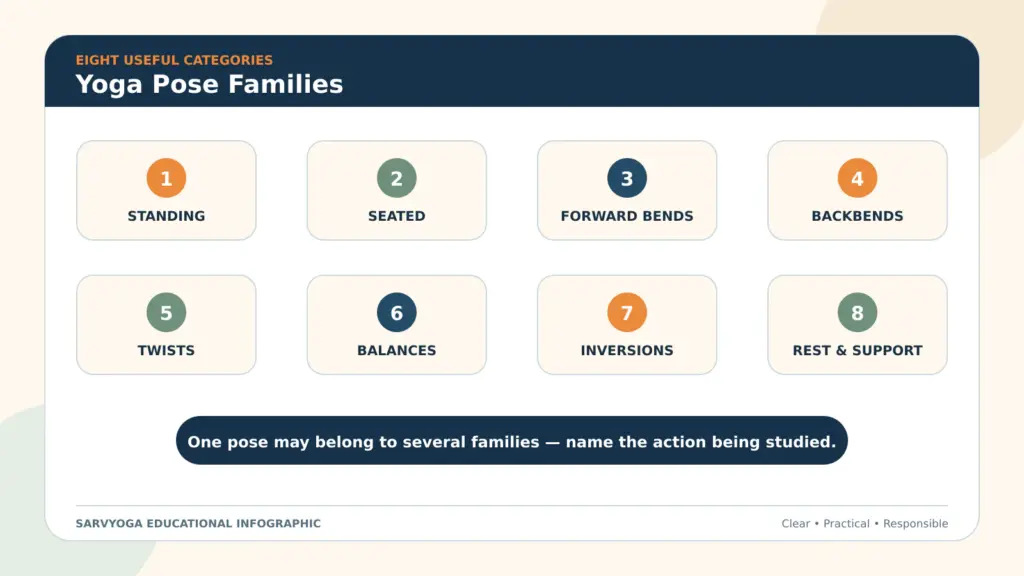
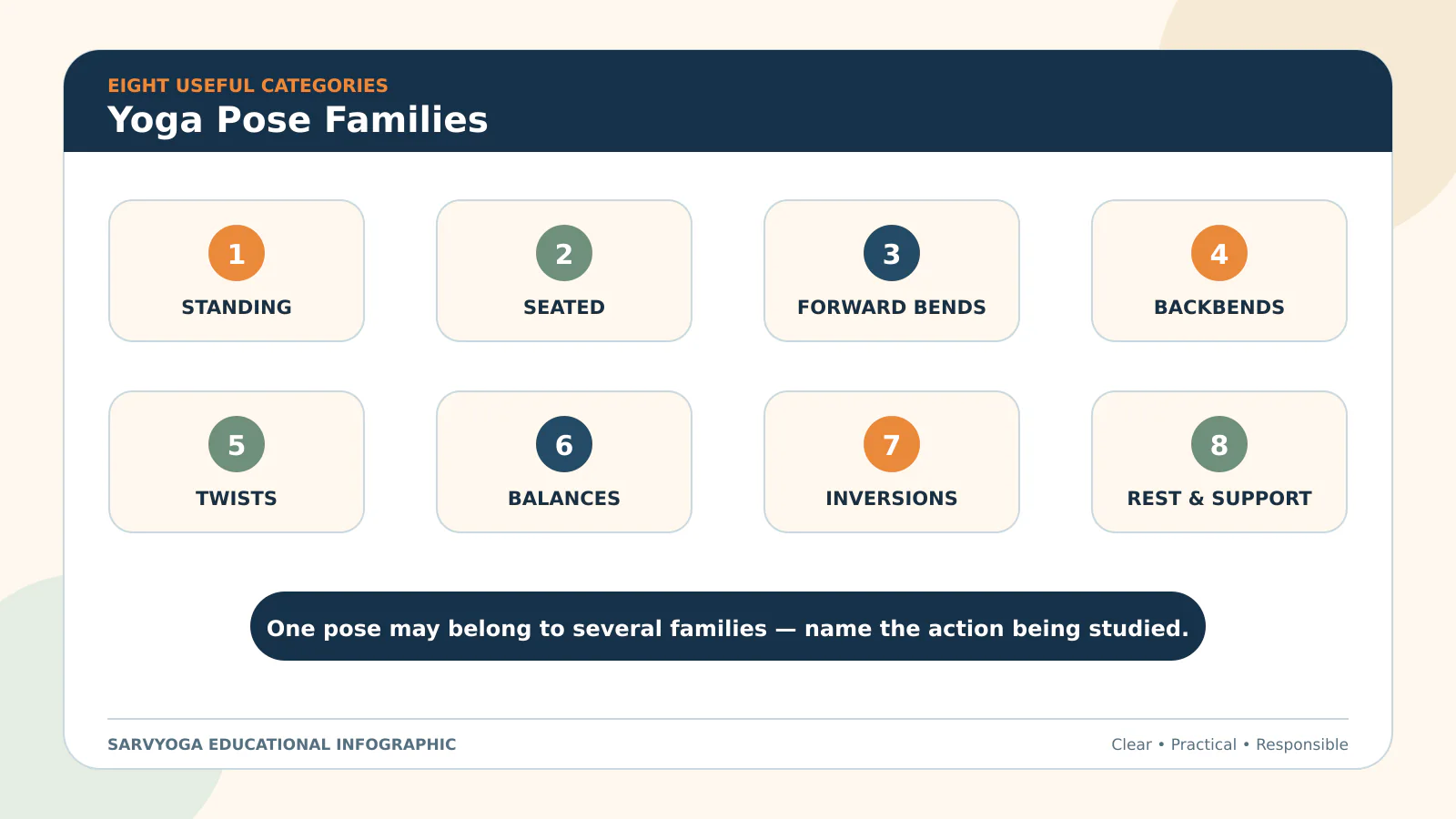
Yoga pose families group asanas by orientation, spinal action, balance demand or use in a sequence. Standing poses, forward bends, twists and backbends are familiar examples. The categories help practitioners recognise shared actions and prepare one pose through another.
These groups are not rigid. Trikonasana is a standing pose and a lateral movement; Ardha Chandrasana is a standing pose and a balance. The most useful category depends on what the teacher or practitioner is studying.
Navigator
Why Learn Pose Families?
- To identify the main action of an unfamiliar pose.
- To choose preparation that relates to the final shape.
- To organise a sequence without selecting poses at random.
- To notice which kinds of movement appear often or rarely in personal practice.
- To choose a simpler pose from the same family when a complex version is unclear.
1. Standing Poses
Standing poses establish the relationship between the feet, legs, pelvis and spine. They can introduce direction, weight transfer and a strong connection to the floor.
Examples include Tadasana, Trikonasana, Virabhadrasana variations and Deviasana.
Sequencing role: standing poses often appear after joint preparation and before floor work. They can also be the entire focus of a short practice.
2. Seated Poses
Seated poses include simple bases for observation, leg arrangements that develop hip movement and upright positions that prepare for forward bends or twists. Seat height strongly affects alignment.
Examples include Dandasana, Sukhasana, Baddha Konasana and Virasana.
Sequencing role: a seated pose may begin pranayama, organise floor work or provide a transition between stronger movement and rest.
3. Forward Bends
Forward bends move the front of the torso toward the legs through a combination of hip flexion and spinal flexion. The balance between those actions changes with the pose and the practitioner.
Examples include Paschimottanasana and Janushirasana.
Sequencing role: prepare with pelvic movement, leg support and a clear hip hinge. A forward bend is not automatically a resting pose; its level of effort depends on the version.
4. Backbends
Backbends extend the spine and often involve shoulder flexion, hip extension or both. Effective preparation distributes the extension instead of concentrating it in one region.
Examples include Bhujangasana, Setu Bandhasana and Ustrasana.
Sequencing role: begin with smaller ranges, prepare the shoulders and hips as needed, and settle gradually afterward. The opposite movement should not be abrupt or extreme.
5. Twists
Twists rotate the spine while the pelvis may remain stable, participate in the turn or move in the opposite direction. Length and support should be established before adding leverage.
Examples include Vakrasana, Ardha Matsyendrasana and Markatasana.
Sequencing role: twists can organise attention after symmetrical work or prepare for poses that combine rotation with balance. Practise both sides without forcing equal range.
6. Balance Poses
Balance poses reduce or change the base of support. They include standing balances, arm balances and some kneeling or seated balances. A wall, chair or block is part of skilled practice, not evidence that the pose is incomplete.
Examples include Vrikshasana, Garudasana, Ardha Chandrasana and Mayurasana.
Sequencing role: practise balance after the relevant joints and actions are prepared, but before fatigue makes the base unreliable.
7. Inversions
Inversions place the pelvis above the heart, or the heart above the head, depending on how a tradition defines the group. The category ranges from supported, mild positions to demanding weight-bearing postures.
Examples include Ardha Halasana, Halasana and Sarvangasana.
Sequencing role: inversions require specific preparation, an appropriate exit and qualified guidance for unfamiliar versions. A supported alternative may better match the session.
8. Restorative and Resting Poses
Resting poses reduce active effort and use the floor or props for support. Restorative yoga uses carefully arranged support and time; not every comfortable-looking pose is automatically restorative.
Examples include supported reclining positions and Shavasana.
Sequencing role: rest can appear between demanding stages and should be given enough time at the end for the practice to settle.
Other Useful Ways to Classify Asanas
The same pose library can be organised through different questions:
- Is the pose symmetrical or asymmetrical?
- Is the base standing, seated, kneeling, prone or supine?
- Is the spine neutral, flexed, extended, rotated or side-bent?
- Is the main demand mobility, stability, balance or coordination?
- Does the pose support preparation, focused work, transition or rest?
This multi-layered view is more accurate than assigning every pose to only one box.
How to Build a Family-Based Practice
- Choose one family as the main study.
- Select two foundation poses from that family.
- Add one preparation from another family if it supports the required action.
- Practise one more complex pose in stages.
- Return to a simpler pose from the original family.
- Settle with an appropriate resting position.
For example, a twist-focused session may begin with a seated base, use Cat and Cow Pose for spinal awareness, explore Vakrasana and Ardha Matsyendrasana, then return to a symmetrical seat before rest.
Common Classification Mistakes
- Assuming every pose belongs to only one family.
- Believing a sequence must contain every family to be balanced.
- Treating all forward bends as restful or all backbends as advanced.
- Grouping poses only by their final appearance and ignoring the main action.
- Using an advanced pose as the only representative of a family.
- Choosing a counterpose solely because it belongs to the opposite category.
Teacher’s Note: Name the Action Being Taught
When a pose fits several families, state the action that matters in that lesson. “We are using Trikonasana to study lateral length” is clearer than simply calling it a standing pose. “We are using Ardha Chandrasana to study weight transfer” gives the balance a practical focus.
This language helps students connect poses that look different but share a learning principle.
Practice Limits
Choose familiar, supported versions and stop or modify for sharp discomfort, numbness, tingling, loss of orientation or restricted breathing. Pose-family knowledge supports planning, but it does not replace individual assessment or qualified teaching for unfamiliar and advanced asanas.
Frequently Asked Questions
How many yoga pose families are there?
There is no single universal number. Eight is a useful teaching framework, while other systems use more or fewer categories.
Are Sun Salutations a pose family?
Surya Namaskar is a sequence that moves through several pose families rather than one isolated family.
Does a balanced class need every family?
No. A balanced class needs a coherent purpose, suitable preparation, proportionate effort, thoughtful transitions and enough rest.