
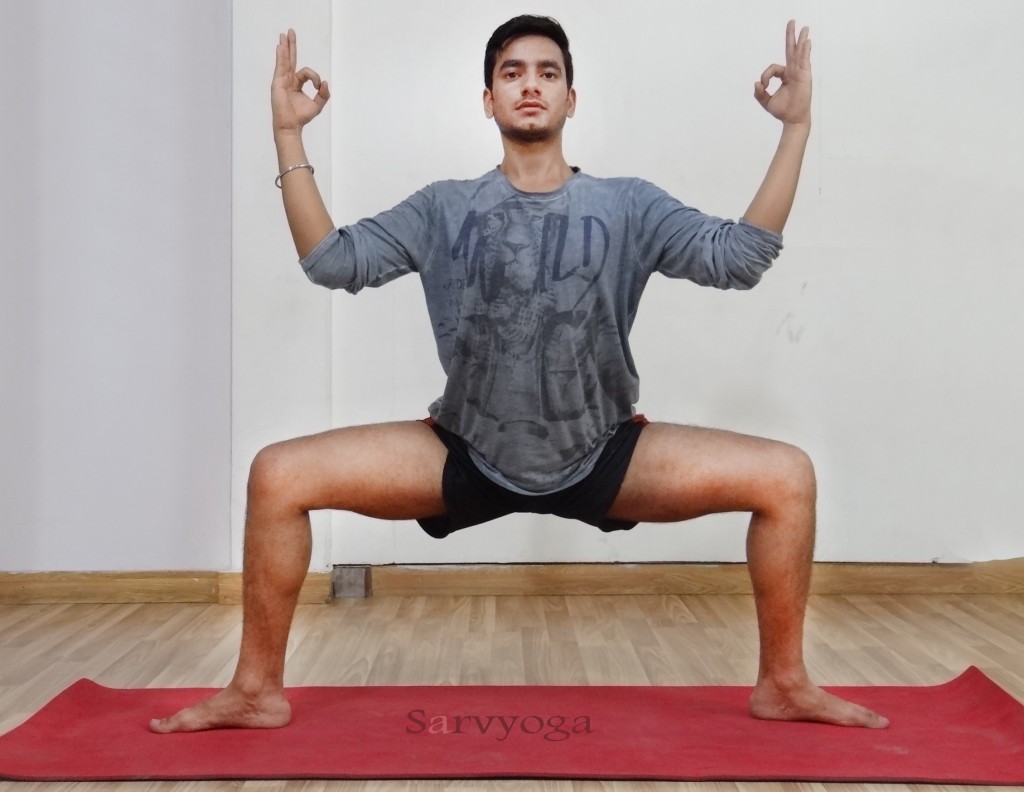
Deviasana (Goddess Pose) is a wide-standing squat used to practise leg strength, hip control and upright alignment. The depth of the squat is optional. A stable stance with well-tracked knees is more useful than lowering as far as possible.
Navigator
Deviasana Steps
- Stand with the feet comfortably wider than hip-width.
- Turn the toes outward only as far as the knees can follow the same direction.
- Keep the spine tall and the pelvis neutral rather than strongly tucking or arching.
- Inhale to prepare.
- Exhale and bend the knees, lowering only to a depth you can control.
- Keep the knees moving in the same direction as the middle toes.
- Bring the hands to the hips, prayer position or another comfortable arm position.
- Stay for several steady breaths.
- Press through the feet and straighten the legs slowly to return to standing.
Alignment Points
- Keep the whole foot grounded.
- Avoid allowing the knees to collapse inward.
- Keep the chest upright instead of leaning far forward.
- Let the squat depth be determined by control, not by how wide the stance looks.
- Keep the neck long and jaw relaxed.
Breathing
Breathe continuously. An easy pattern is to inhale while standing tall and exhale while bending the knees. Once in the pose, use natural breathing without trying to hold a fixed breath ratio.
Beginner Modifications
- Use a wall behind the back for orientation.
- Keep the squat shallow.
- Place the hands on the thighs or hips instead of raising the arms.
- Use a chair in front for light hand support when balance is uncertain.
- Narrow the stance if the hips or knees feel strained.
Common Mistakes
- Turning the feet out farther than the knees can follow.
- Dropping too low and losing control of the knees.
- Rolling onto the inner edges of the feet.
- Arching the lower back to keep the chest upright.
- Holding the breath.
Possible Practice Benefits
Deviasana can develop awareness of lower-body alignment, controlled knee bending, upright squat mechanics and balance in a wide stance. It may also be used to build endurance gradually when repetitions or holding time are increased conservatively.
Practice Limits
Stop for sharp knee, hip, ankle or back pain, dizziness or loss of balance. Reduce the stance width and squat depth when the knees cannot comfortably track with the toes. Practise with a qualified yoga teacher when you need individual help with stance or joint alignment.
How to Choose Your Squat Depth
Use the feet and knees as feedback. Lower only while the heels remain grounded, the knees continue to track with the toes and the torso can stay organised without excessive arching. If any of those points change, rise slightly. Over several sessions you may be able to stay a little longer or move a little deeper, but neither is required. A shallower pose with stable alignment is a better learning tool than a deep squat that is difficult to control.
Simple Practice Progression
Start with three slow repetitions instead of a long hold. Inhale while standing, exhale into a shallow squat and return smoothly. When this feels steady, pause for one or two breaths in the lower position. Later you can explore different arm positions while keeping the same lower-body alignment. Changing one element at a time makes it easier to understand whether a new variation actually improves the practice.
Where Goddess Pose Fits in a Sequence
Deviasana works well after basic standing alignment and before more complex wide-legged poses. Return to a neutral standing position afterward and notice the feet, knees and breathing. Beginners can alternate Deviasana with Tadasana so that a wide stance is followed by a simpler base. This creates a clear contrast between stability, knee bending and upright posture.
Frequently Asked Questions
How wide should my feet be?
Only wide enough that you can keep the whole foot grounded and the knees aligned with the toes.
Do I need to squat deeply?
No. A shallow, well-controlled Deviasana is preferable to a deeper squat with collapsing knees or a strained back.
Where should I place my arms?
Hands on the hips or in front of the chest are suitable for learning. Add more demanding arm positions only after the lower-body alignment feels steady.
Could you pl mention the effect of Utkata konasana on Vata , Pitta and kapha? Or its effect on Chakras.
It has been mentioned that Utkata konasana increases body heat ; does it mean increase of Pitta dosha ? If yes , can Pitta type individuals practise this asana ? Pl guide.