
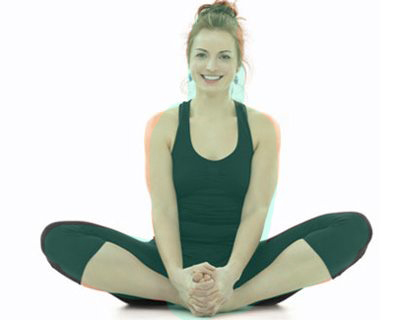
Baddha Konasana, commonly called Bound Angle Pose, is a seated asana in which the soles of the feet meet and the knees open to the sides. The Sanskrit name combines baddha, meaning bound, with kona, meaning angle. The posture is best understood as an adjustable seated shape rather than a test of how close the knees come to the floor.
The distance between the heels and pelvis, the height beneath the sitting bones and the support beneath each thigh can all change. A steady version keeps the pelvis balanced, the spine comfortably upright and the breath natural.

Navigator
Prepare the Seated Base
Sit on a firm mat with two folded blankets and two blocks nearby. Extend the legs briefly and notice whether the pelvis tips backward. If the lower back rounds before the knees bend, place one or more folded blankets beneath the sitting bones. The support should be wide enough for both sides of the pelvis.
- Begin with the feet farther from the pelvis.
- Place equal support beneath both outer thighs, then adjust each side separately.
- Keep the feet relaxed instead of pulling their outer edges apart.
- Use the hands behind the pelvis when holding the ankles rounds the spine.
Step-by-Step Baddha Konasana
- Sit with both legs extended and the hands beside the hips.
- Bend one knee and then the other, bringing the soles of the feet together.
- Move the heels to a distance that allows the pelvis to remain balanced.
- Rest the hands on the ankles or place them behind the body for support.
- Let the thighs move outward without pressing them down.
- Lift through the crown of the head while keeping the ribs quiet.
- Stay for three to eight natural breaths, observing both sides.
- Use the hands to guide the knees toward one another before extending the legs.
Pelvis, Knee and Foot Alignment
The outward movement begins at the hips. The knees follow that movement and do not need to reach a particular height. If one knee remains higher, support it at its natural level. Pressing or bouncing the thighs can obscure the useful feedback that the pose provides.
Keep the inner and outer edges of the feet together without gripping the toes. The ankles should feel neutral rather than twisted. Lengthen the front and back of the torso together so the chest does not lift by over-arching the lower back.
Blanket, Block and Chair Options
- Elevated seat: add blanket height until the spine can rise with less effort.
- Supported thighs: place blocks or folded blankets beneath the outer thighs.
- Wider diamond: move the heels farther forward to make a larger leg shape.
- Wall support: sit with the back lightly against a wall while keeping the head free.
- Chair version: sit toward the front of a chair, place the feet apart and allow the knees to open only within a steady range.
Sukhasana is a useful alternative when bringing the soles together does not provide a clear seated base.
Forward-Fold Option
An upright Baddha Konasana is complete. To explore a forward inclination, hinge from the hips with the spine long and place the hands or forearms on firm support. Stop before the pelvis rolls strongly backward or the knees feel pressured. A bolster arranged lengthwise can support the torso while the thighs remain supported separately.
Common Mistakes
- Pulling the heels close because the pose is assumed to have one fixed shape.
- Pressing the knees or asking another person to push them downward.
- Rounding the spine while trying to sit lower.
- Ignoring a clear difference between the two sides.
- Holding the breath or tightening the jaw.
- Leaving the pose quickly without supporting the legs.
Using the Pose in Practice
Baddha Konasana can follow simple standing work or appear within a seated sequence. It develops attention to pelvic balance, hip rotation and the relationship between support and ease. It may be followed by Vajrasana or a comfortable leg extension so the knees move through a different angle.
Practice Limits and Teacher Guidance
Reduce the range or leave the pose for sharp discomfort, numbness, tingling or a feeling of pressure in the knees, hips or ankles. More support is preferable to forcing the legs lower. A qualified yoga teacher can help choose seat height, foot distance and separate support for each side.
Frequently Asked Questions
Should the knees touch the floor?
No. The useful height is the one at which the hips, knees and breath remain steady.
How close should the heels be?
Choose the distance that allows the pelvis to balance without pulling at the knees or ankles.
Can the pose be practised on a chair?
Yes. A chair version keeps the torso upright and lets the feet and knees move only as far as comfortable.
My prostate is enlarged.
Please suggest some remedies.
Thanks
First of all, drink water sip by sip not instantly and in the sitting position. Taking Dates is very beneficial for your problem. Boil 2 to 4 Dates (Remove the seed and cut in small pieces) in milk and take that milk before sleeping and chew the rest of Dates. Do this Regularly for One to two months. Here are some Asana given below: –
1.Sirshasana.
2.Sarvangasana.
3.Paripuran Navasana (Full Boat Pose).
4.Mandukasana (Iyenger style).
5.Ardha Mastyendrasana.
6.Supta Padangusthasana.
7.Baddha Konasana.
8.Janusirsasana.
9.Virasana (Hero Pose).
These Asana & Remedy is beneficial in BPH. Please also take advice from An Ayurvedic Doctor.
Thank you.