
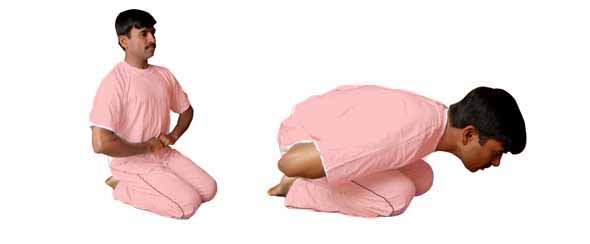
Mandukasana (Frog Pose) is a kneeling yoga posture that combines a steady base with a gentle forward inclination. In SarvYoga’s version, the emphasis is on comfortable knee placement, relaxed breathing, controlled pressure through the hands and a range that does not force the abdomen or spine.
Navigator
Before You Practise Mandukasana
Begin from a comfortable kneeling position such as Vajrasana. If the knees or ankles feel compressed, place a folded blanket under the knees or between the calves and thighs. Keep the breath natural and avoid using the hands to push deeply into the abdomen.
Mandukasana Steps
- Sit in a comfortable kneeling position with the spine upright and shoulders relaxed.
- Make a loose fist with each hand, keeping the thumbs in a comfortable position rather than pressing sharply into the body.
- Place the hands gently near the lower abdomen according to the variation taught to you.
- Inhale naturally and lengthen through the crown of the head.
- Exhale and incline the torso forward from the hips while keeping the neck long.
- Stop before the knees, abdomen, wrists or lower back feel compressed or painful.
- Stay for a few easy breaths without straining or holding the breath.
- Inhale and return slowly to upright sitting. Relax the hands and breathe normally.
Second Hand-Placement Variation
Some schools teach a variation in which one palm is placed over the other instead of using fists. Consider this a different hand position, not a deeper version. The useful range is the one that allows steady breathing and a controlled return to upright sitting.
Breathing and Alignment
- Keep the breath continuous throughout the pose.
- Move from the hips rather than rounding the upper back aggressively.
- Keep the shoulders away from the ears and the jaw relaxed.
- Use only light, comfortable hand contact.
- Keep the movement symmetrical unless a teacher has given you a specific variation.
Beginner Modifications
- Place a folded blanket beneath the knees or ankles.
- Keep the torso more upright and use a smaller forward inclination.
- Rest the hands on the thighs if abdominal contact is uncomfortable.
- Practise Vajrasana first to become comfortable in kneeling.
Common Mistakes
- Forcing the torso downward to imitate a photograph.
- Pressing the fists or thumbs sharply into the abdomen.
- Holding the breath during the forward movement.
- Ignoring knee or ankle discomfort.
- Returning to upright sitting too quickly.
Possible Practice Benefits
Mandukasana can be used to practise kneeling stability, hip-hinge awareness, controlled forward movement and steady breathing. It may also help a practitioner notice how abdominal contact changes the experience of a forward inclination. These are practice observations rather than promises of a specific outcome.
Precautions and When to Stop
Stop for sharp knee, ankle, abdominal, wrist or back pain, dizziness, breathlessness or a feeling of strong internal pressure. Avoid forcing the posture after a recent injury or a period of restricted movement. When your movement needs individual adaptation, work with a qualified yoga teacher who can observe your alignment directly.
How to Progress the Pose
Progress in Mandukasana does not have to mean folding farther. First make the kneeling base comfortable, then practise a smooth hip hinge, and only then explore a slightly greater forward angle. A useful progression is to keep the hands light for several sessions, observe whether the shoulders and jaw remain relaxed, and increase the range only when the breath stays unchanged. This makes the pose easier to repeat consistently and reduces the tendency to chase a dramatic final shape.
Where Mandukasana Fits in a Practice
Mandukasana can follow a short kneeling warm-up and a few easy spinal movements. After the pose, return to an upright kneeling or comfortable seated position and notice the breath before moving on. If the knees have worked hard, a supported Child Pose or a change to a non-kneeling posture can provide variety. The pose does not need many repetitions; one or two carefully observed rounds are enough for an educational practice.
Teacher Observation Points
When learning in a class, ask the teacher to observe the kneeling base, the direction of the hip hinge and whether the shoulders tense as you move forward. These details are more informative than how close the torso comes to the floor. A teacher may also suggest changing the blanket height, hand position or range between sides of the practice. Use those adjustments as learning tools rather than signs that the pose must look one particular way.
Frequently Asked Questions
Is Mandukasana mainly an abdominal-pressure exercise?
No. It is better approached as a controlled kneeling and forward-inclination practice. Strong abdominal pressure is not required.
Can I practise Mandukasana with sensitive knees?
Use generous support, reduce the kneeling time and keep the torso more upright. Stop if the knees remain uncomfortable.
How long should I hold the pose?
A few comfortable breaths are enough for most learning sessions. Quality of alignment and breathing matters more than holding time.
Can I practise immediately after eating?
Avoid a strong forward-inclination practice when the abdomen feels full. Choose a comfortable time in your routine and keep the movement gentle.
I have knee pain so can not sit in bajrason position, please let me know other way to do mundukason by avoiding bajrason.
Tadasana (mountain Pose), Trikonasana (triangle Pose) , Ustrasana (Camel Pose) these are beneficial Asana for knee pain. so you can Try these Asana regularly. when you are comfortable perform mandukasana.
Can mandukasana be done while having kidney stone.
@Raw, in kidney stone avoid this.
There is gap between ankles and hip while going down how to fix it …. or is it ok ……
Om! @Vikas, First place your feet in the v shape, as shown in the above video, for the first time its ok. If you feel some discomfort during this then there is no need to fix it. Do all the Yogic activities under the supervision of an expert person.
Please follow the instruction carefully, while you’re performing Any Pose. Keep concentrate on breathing.
Thanks for your precious comment.
Keep connected with us.
May God Bless You.
Can this asan give you diarrhoea?
First, of all thanks for your words. There is no proof that, this asana leads to diarrhoea. Without any doubt you can perform this asana.But if you are suffering from diarrhoea then avoid this. And in case of kidney stone also avoid this asana.
May God bless you.
Keep connected with us.
Practising regularly mudhukasana, but still suffering from incomplete bowel evacuation.
Sir, how does this aasan exactly help in reducing the back pain?
@MAYURI,
Thanks for your precious comment. As in this you have to lean forward this movement targets the back by which it may cures back pain. Remember one thing in severe back pain avoid forward bending intense Asana but you can practice this Asana due to it’s simplicity.
Thanks! and if you have any doubts then without any hesitation ask us.
Keep visiting our Website.
May God Bless You.
We are doing Mandukasan since one year . I noticed my upper part of stomach bulging out
Do you think I am doing not right way the asan
Thanks
Kanti
What Asan my wife should do for lower back pain .She is 56 years old .Please advice
please visit yoga for lower back pain