
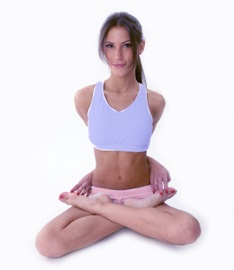
Baddha Padmasana, or Bound Lotus Pose, combines the crossed-leg base of Padmasana with an arm bind behind the back. The Sanskrit word baddha means bound, padma means lotus and asana means posture.
This is an advanced seated asana. The lotus base and shoulder bind should each be available without force before they are combined. A strap, Half Lotus or a simple cross-legged seat can preserve the main learning actions without requiring the complete shape.
Navigator
Understand the Prerequisites
Before practising the bind, sit comfortably in Sukhasana and explore Titli Asana with gentle movement. Padmasana should be learned gradually, with movement coming primarily from the hips rather than being forced through the knees.
- Sit upright without pressure in the knees or ankles.
- Move each shoulder into extension separately.
- Hold a strap behind the back with wide hands.
- Practise Half Lotus on both sides before considering full Lotus.
- Be able to release the leg position slowly without using the hands aggressively.
Shoulder and Arm Preparation
Hold a strap behind the back with both hands and gradually narrow the grip while keeping the chest easy. Then take one arm behind the waist and slide the hand toward the opposite side. Repeat with the other arm.
For the toe-reaching action, the shoulder extends and rotates while the hand passes behind the back. The torso should not twist sharply to create the reach. If the toe is not naturally available, hold a strap looped around the foot.
Teacher-Led Baddha Padmasana Steps
- Sit on a folded blanket with the spine upright.
- Arrange Padmasana only if both sides of the lotus position are already comfortable.
- Check that the knees feel supported and the ankles are not sickling.
- Take the right arm behind the back and reach toward the right foot.
- Hold the foot or a strap without pulling the shoulder forward.
- Take the left arm behind and reach for the left foot or strap.
- Lift through the crown of the head and broaden the collarbones.
- Take several ordinary breaths.
- Release the hands first, then unfold the legs one at a time.
- Repeat with the opposite leg arrangement only when both sides remain comfortable.
Strap-Assisted and Non-Lotus Options
Loop a strap around each foot before arranging the seated base, leaving enough length to reach behind the body. Hold the straps rather than the toes. A Half Lotus version uses one lotus leg while the other leg rests in a simple cross-legged position.
A non-lotus version can be practised in Sukhasana: take both arms behind the back and hold a strap, then lengthen the spine. This version develops the shoulder action without loading folded knees. It is often the most useful option for regular study.
Alignment Cues
- Keep the sitting bones grounded evenly.
- Let the knees descend only through available hip movement.
- Maintain length through the sides of the waist.
- Broaden the collarbones without thrusting the ribs forward.
- Keep the head balanced over the pelvis.
- Release the bind before changing the legs.
Common Mistakes
- Pulling the feet into Lotus with the hands.
- Continuing when a knee or ankle feels compressed.
- Forcing the fingers to reach the toes.
- Rounding the spine and dropping the head.
- Holding the breath while arranging the bind.
- Trying Kukkutasana before the seated base is steady.
Practice Effects
The pose combines detailed leg organisation, shoulder extension and upright seated attention. Strap-assisted work can clarify the direction of the bind, while non-lotus versions allow the practitioner to study the upper-body action independently.
Practice Limits
Leave the setup immediately when there is sharp discomfort, tingling, numbness or unstable joint pressure. Do not push the knees downward, pull the feet into place or force the shoulders behind the body. Study Padmasana and the bind separately with a qualified yoga teacher before combining them.
Frequently Asked Questions
Can I use a strap?
Yes. Holding a strap is a complete learning variation when the toes are not comfortably reachable.
Is Half Lotus suitable?
Yes, provided the folded leg remains easy and the other leg has clear support.
Must both hands hold the toes?
No. One hand, two straps or a simple behind-the-back strap hold are valid options.