
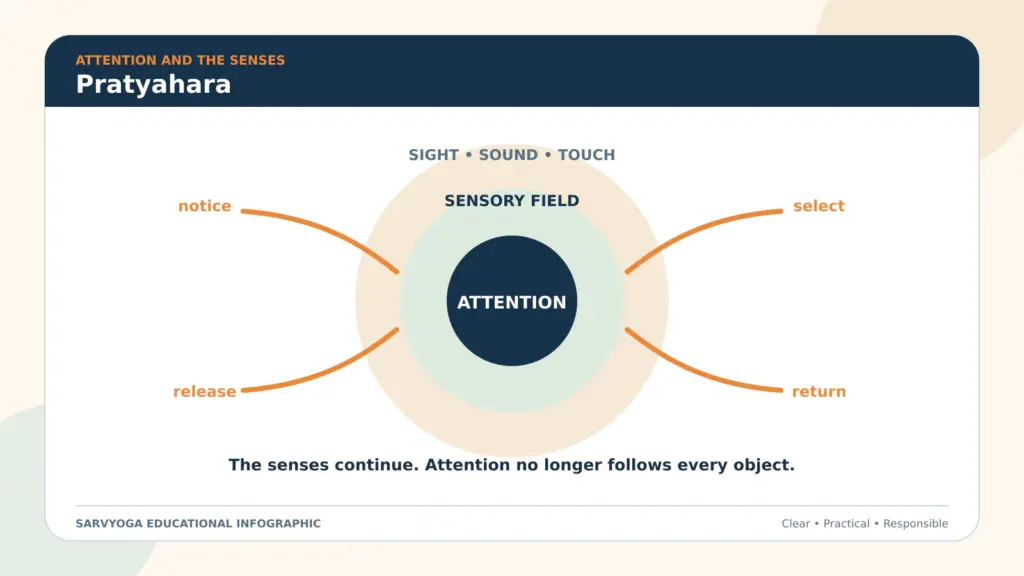
Pratyahara is the fifth limb in Patanjali’s eight-limbed yoga. It is commonly translated as withdrawal of the senses, but “withdrawal” can sound more forceful than the practice needs to be. Pratyahara studies how attention can stop following every sensory object and become available for concentration.
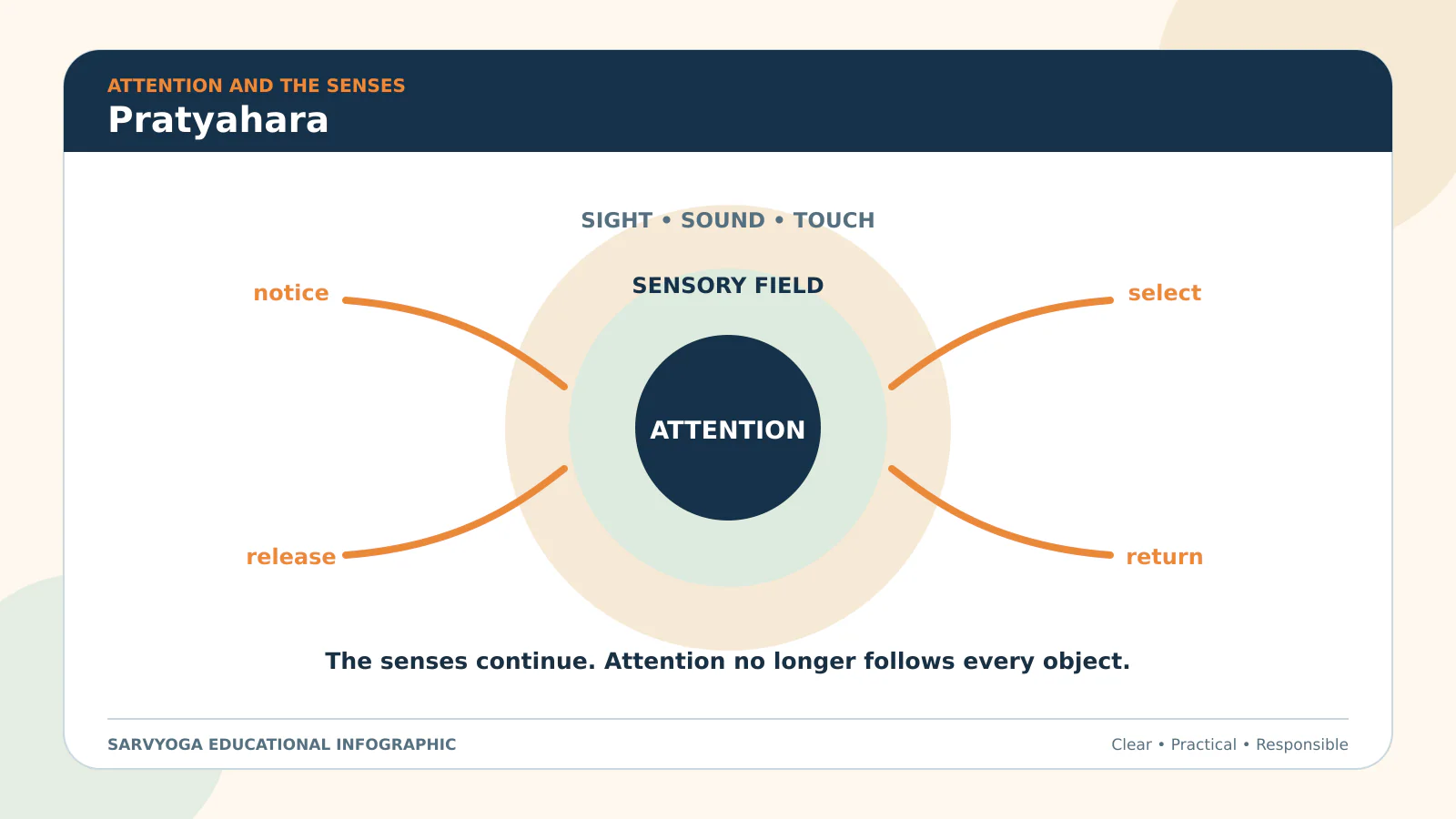
The senses continue to function. Sounds may still be heard and contact with the floor may still be felt. The change lies in participation: not every sound, sight or sensation must become the next object of attention.
Navigator
Meaning of the Word Pratyahara
Prati can suggest turning back, against or toward, while ahara refers to taking in, nourishment or input. The compound is often understood as drawing the senses away from their objects. Translation varies, and the practical meaning becomes clearer through experience than through one English phrase.
Pratyahara in the Eight Limbs
- Yama — ethical disciplines
- Niyama — personal observances
- Asana — posture
- Pranayama — regulation and study of breath
- Pratyahara — change in the relationship between senses and attention
- Dharana — concentration
- Dhyana — meditation
- Samadhi — meditative absorption
Its position is important. Asana and pranayama organise posture and breath; Dharana and Dhyana require a more sustained direction of attention. Pratyahara is often described as a bridge between outward-facing and inward-facing practice.
What Pratyahara Is Not
- It is not making the room completely silent.
- It is not closing the eyes and pretending sensory input has disappeared.
- It is not rejecting the body.
- It is not forcing the mind to become blank.
- It is not permanent isolation from ordinary life.
External simplicity can support practice, but the central study is how attention responds when stimulation is present.
Begin with Sensory Awareness
Before attention can disengage from sensory objects, the practitioner needs to notice how it moves toward them.
- Sit on a chair or in a supported floor seat.
- Keep the eyes softly open.
- Notice one sound without identifying its source in detail.
- Notice contact with the seat and floor.
- Notice the visual field without choosing a particular object.
- Observe which sense repeatedly captures attention.
This is not yet withdrawal. It is the clear observation that makes a deliberate change possible.
Practice 1: From One Sound to the Whole Field
- Sit comfortably and listen to the most obvious sound.
- After several breaths, include quieter sounds.
- Let the sounds form one field rather than naming each source.
- Notice that hearing continues without following every sound.
- Return attention to the seated base and natural breath.
This method does not require silence. It changes the habit of selecting, naming and pursuing each sound.
Practice 2: Soft Gaze to Closed Eyes
- Choose one plain point at eye level or slightly below.
- Use a soft gaze for three natural breaths.
- Widen attention to include peripheral vision.
- Lower the eyelids halfway and observe the change in visual input.
- Close the eyes only if orientation remains steady.
- Notice light, colour or movement behind the eyelids without following it.
The Trataka guide describes a separate gazing practice. Do not treat every use of the eyes as Trataka.
Practice 3: Body Contact and Breath
- Lie down in a supported rest or sit in a stable chair.
- Notice three clear points of contact with the floor or support.
- Move attention from one point to the next.
- Then notice all three together.
- Let contact remain in the background while the natural breath becomes the foreground.
- Reverse the relationship: breath in the background, contact in the foreground.
This shows that attention can select and release an object while sensory information continues.
Pratyahara in Daily Life
Daily examples should be understood as preparation, not as complete equivalents of the classical limb.
- Finishing one page before checking a notification.
- Eating one meal without continuous screen input.
- Pausing before responding to a new sound or message.
- Keeping one quiet transition between work and personal practice.
- Choosing when to engage with stimulation rather than reacting automatically.
Relationship with Pranayama
A simple breathing practice can give attention one continuous reference. The purpose is not to block the senses with breath but to reduce the need to follow competing objects. Begin with ordinary breath awareness or a familiar, gentle technique.
Bhramari Pranayama uses humming sound as an object of attention. Learn its pacing and limits separately before placing it in a longer seated practice.
Common Mistakes
- Trying to suppress every sound, sensation or thought.
- Choosing an uncomfortable seat because stillness is considered more important than clarity.
- Closing the eyes when it reduces orientation.
- Practising in complete silence and then assuming the skill will transfer automatically to a busy setting.
- Using sensory reduction as avoidance of responsibilities.
- Moving immediately into a long concentration practice without a gradual transition.
Teacher’s Note: Practise Selection Before Withdrawal
Students often interpret “sense withdrawal” as an instruction to stop hearing or feeling. Begin by showing that attention can select one sound, widen to the whole sound field and then rest with the breath while sounds continue. The ability to choose is more instructive than the attempt to shut sensory experience down.
Keep early practices short and finish by reopening the visual field, moving the hands and feet and noticing the room.
A Ten-Minute Beginner Outline
- Settle posture and observe natural breath: two minutes.
- Listen from one sound to the whole sound field: two minutes.
- Notice three body-contact points: two minutes.
- Let contact move to the background while observing breath: two minutes.
- Open the eyes, orient to the room and finish: two minutes.
Practice Limits
Stop and reorient if the practice creates dizziness, distress, loss of orientation or unusual discomfort. Keep the eyes open and choose a shorter session when inward attention is not steady. Pratyahara is a classical study that benefits from qualified guidance and gradual learning.
Frequently Asked Questions
Does Pratyahara mean blocking the five senses?
No. Sensory function continues. The practice changes how automatically attention follows sensory objects.
Is closing the eyes Pratyahara?
Closing the eyes reduces visual input, but it is only a support. Pratyahara concerns the relationship between attention and sensory experience.
Should Pratyahara be practised before meditation?
It can provide a useful transition into concentration, but the limbs develop together rather than as a checklist completed once.