
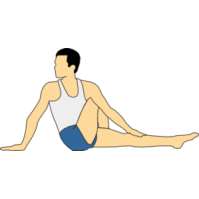
Vakrasana is a simple seated twist often used to learn spinal length and controlled rotation before deeper twisting postures. The pose begins from a stable sitting base, and the arms guide the direction rather than pulling the torso into a larger range.
Navigator
Meaning of Vakrasana
Vakra means bent, curved or twisted, and asana means posture. The name refers to the turning shape of the seated pose. Instructions vary between schools, particularly in the position of the bent leg and the front arm.
Prepare the Seat
- Sit on a folded blanket if the pelvis rolls backward.
- Extend both legs forward without forcing the knees straight.
- Place the hands beside the hips and lift through the spine.
- Keep the chin level and the shoulders relaxed.
- Take several ordinary breaths before adding the twist.
Vakrasana Steps
- Begin with both legs extended in front.
- Bend the right knee and place the right foot on the floor beside the left knee or calf.
- Keep the left leg extended and the foot active without hardening the knee.
- Place the right hand behind the pelvis for light support.
- Bring the left hand or forearm to the outside of the right leg.
- Inhale and lengthen from the sitting bones through the crown of the head.
- Exhale and rotate gently to the right through the ribs and upper back.
- Turn the head only as far as the neck remains comfortable.
- Stay for several natural breaths, renewing spinal length on each inhalation.
- Return to the centre on an inhalation and extend the right leg.
- Repeat on the left side.
Where the Twist Comes From
The rotation is distributed through the spine, with attention to the ribs and upper back. The pelvis stays grounded, but it does not need to be clamped rigidly. Create length before rotation and use a smaller range if the lower back rounds.
The rear hand is a support, not a lever. Pressing hard into it can lift the shoulder and move the chest forward instead of creating a balanced twist.
Chair Variation
- Sit sideways on a stable chair with both feet supported.
- Hold the sides or back of the chair lightly.
- Inhale to sit taller.
- Exhale and rotate through a comfortable range.
- Keep both knees facing forward and the shoulders level.
- Return to the centre and change sides.
The chair variation is useful when sitting on the floor makes the pelvis roll backward or distracts from the turning action.
Other Modifications
- Keep the bent foot on the inner side of the extended knee.
- Hold the bent knee instead of placing the arm outside it.
- Use a folded blanket under the sitting bones.
- Bend the extended knee slightly.
- Keep the gaze forward if turning the head affects the ease of the neck.
Alignment Points
- Support both sitting bones.
- Lengthen before rotating.
- Keep the chest broad without pushing the ribs forward.
- Let the shoulders remain level.
- Use the front arm as a gentle guide.
- Keep ordinary breathing throughout the pose.
- Release the twist gradually rather than snapping back to centre.
Common Mistakes
- Rounding the spine before beginning the twist.
- Pulling strongly with the front arm.
- Pressing hard into the rear hand.
- Turning the head farther than the ribs can rotate.
- Allowing the bent foot to lose steady contact with the floor.
- Holding the breath while trying to move deeper.
How to Use Vakrasana in a Sequence
Vakrasana can follow simple seated forward-and-upward movements that prepare an upright base. Practise both sides and return to a neutral seat between them. A gentle symmetrical pose can follow so that the spine and breath settle.
For a deeper seated twist with a different leg arrangement, study Ardha Matsyendrasana separately instead of turning Vakrasana into a stronger bind.
Practice Limits
Reduce or leave the pose if you feel sharp discomfort, tingling or strong compression in the back, hip or knee. Keep the twist open, breathe naturally and avoid using the arms to force rotation. Bound variations belong in teacher-led practice.
Frequently Asked Questions
Should the spine stay completely straight?
Aim for natural length rather than stiffness. Use support under the pelvis if sitting upright is difficult.
How far should I turn?
Turn only while both sitting bones remain supported and the breath stays easy.
Does the head need to look behind?
No. The head may follow the torso gently or remain facing forward.
Can Vakrasana be practised on a chair?
Yes. The chair version provides a stable base and makes the direction of the twist easier to study.
Very very useful