
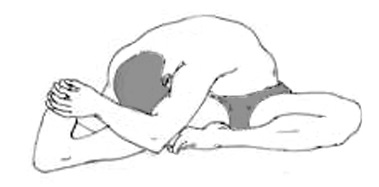
Janushirasana (Head-to-Knee Pose) is a seated forward-folding asana with one leg extended and the other knee bent. The purpose is not to force the head to the knee. A better learning goal is a long spine, a comfortable hip position, steady breathing and a forward fold that matches your current hamstring range.
Navigator
Before You Begin
Sit on a folded blanket if the pelvis rolls backward. Keep a strap nearby when reaching the foot makes the spine round strongly. The bent knee may be supported with a cushion or block so the hip can relax.
Supported Janushirasana Steps
- Sit with both legs extended in front of you.
- Bend the right knee and place the right foot comfortably toward the inner left thigh. Keep the knee supported if it does not rest easily.
- Turn the torso toward the extended left leg without forcing the hips square.
- Inhale and lengthen through the spine.
- Exhale and hinge forward from the hips while keeping the chest broad.
- Hold the shin, ankle, foot or a strap around the foot. Choose the position that lets the shoulders stay relaxed.
- Remain for several easy breaths, allowing the fold to stay steady rather than deepening on every exhalation.
- Inhale to return upright, extend both legs, then repeat on the other side.
Alignment and Breathing
- Let the forward movement begin at the hips.
- Keep the extended knee soft enough that the back of the leg is not aggressively pulled.
- Keep the neck in line with the spine rather than dropping the head to reach the knee.
- Breathe continuously and reduce the fold if breathing becomes restricted.
- Keep both sitting bones grounded as evenly as your hip mobility allows.
Beginner Modifications
- Sit on a folded blanket to help the pelvis tip forward.
- Use a strap around the extended foot instead of reaching with the hands.
- Bend the extended knee slightly.
- Support the bent knee with a cushion.
- Keep the torso nearly upright and practise only the hip hinge.
Common Mistakes
- Pulling hard on the foot to move deeper.
- Rounding the back to make the head reach the knee.
- Forcing the bent knee toward the floor.
- Holding the breath.
- Trying to make both sides look identical.
Possible Practice Benefits
Janushirasana can develop awareness of seated hip position, hamstring range, forward-fold mechanics and slow breathing. It is also useful for learning how props can make a pose more organised rather than simply deeper.
Precautions and When to Modify
Stop for sharp pain in the knee, hip, hamstring or lower back, or for tingling and numbness. Use a smaller range when the extended leg feels strongly pulled. After a recent injury, learn the pose with individual guidance rather than pushing into a fixed shape.
How to Progress Without Pulling
Progress by improving the starting position rather than by pulling harder on the foot. Sit slightly higher, soften the extended knee and find a forward pelvic tilt before folding. Over time, the hands may reach farther naturally, but the main reference points should remain an easy breath and a spine that can lengthen. If the back rounds immediately, come up a little and use a strap. This is still a complete version of Janushirasana.
Using Janushirasana in a Sequence
A gentle seated warm-up can make the pose easier to understand. Begin with comfortable sitting, ankle movement and a mild hamstring preparation before practising one side at a time. After both sides, sit upright for a few breaths or use an easy symmetrical forward fold. Moving slowly between sides also gives you time to notice normal differences in hip and hamstring range rather than trying to make both sides identical.
Frequently Asked Questions
Does the head need to touch the knee?
No. The name describes the direction of the pose, not a requirement. Keep enough space to maintain a long, comfortable spine.
Should the extended knee be completely straight?
No. A slight bend is useful when it improves pelvic position or reduces strain behind the knee.
Can I use a strap?
Yes. A strap can help you keep the spine long without pulling the torso toward the foot.
I am suffering from thigh pain from 4 months please suggest me .asanas and. Ayurvedic medicine
Padangusthasana (Big Toe Pose), Baddha Konasana (Bound Angle Pose), Dhanurasana (Bow Pose), Chair Pose (Utkatasana), Janushirasana, Virasana e.t.c. these Asana are best for thighs and for Ayurvedic medicine please concern an ayurvedic Doctor.
I have got sinus problem for 4 month. Any yoga techniques for the problem?
Thnx @Gaurav for your comment. For Sinus there are some Asana, pranayama and Shatkriyas listed below: Asana:- Gomukhasana, Bhujangasana, Sarvangasana, Ustrasana. In pranayama do Kapalbhati, Bhastrika and Suryabhedan pranayama. In Shatkarma try Sutraneti (Nasal cleansing with Thread, in starting use Rubber Thread for This), Jalneti (Nasal Cleansing with Water),
@Top Yoga Poses to Lose Weight from Hips and Thighs – Weight Sentinel, Thanks for giving your valuable views.