
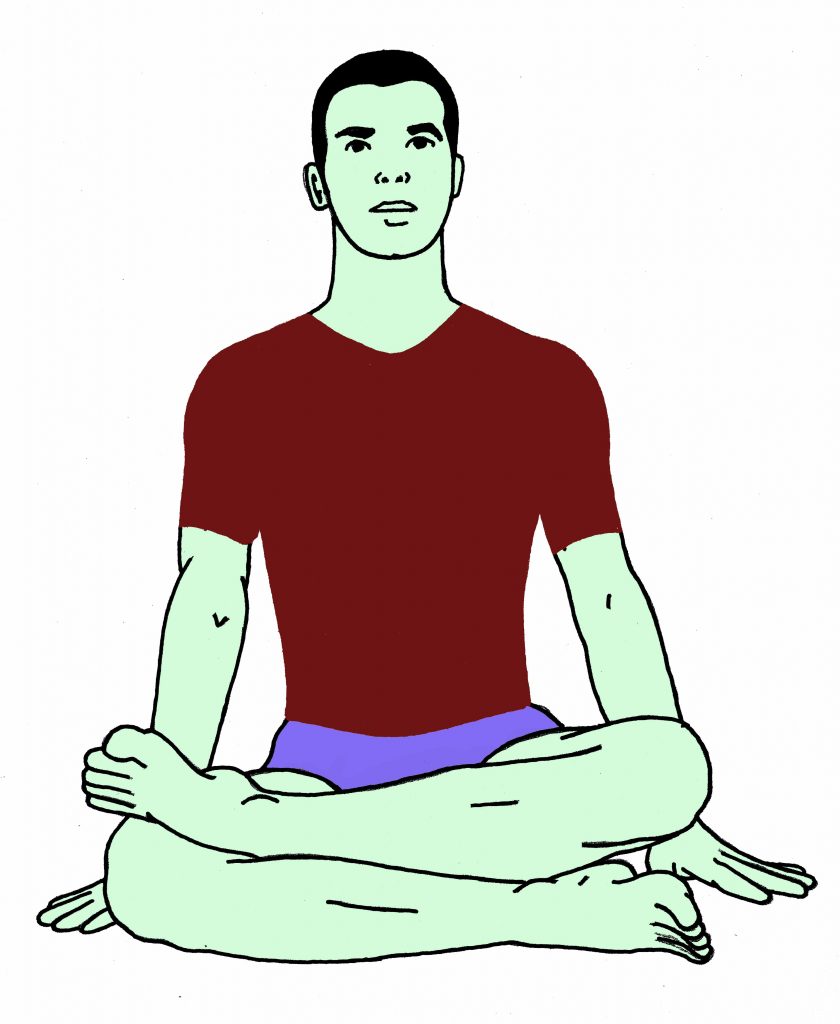
Agnistambhasana is commonly called Fire Log Pose, Burning Log Pose or Double Pigeon. The shins are arranged roughly one above the other while the practitioner sits upright.
This is a demanding hip-rotation posture for many people. The knees should be supported whenever there is a large gap, and the pose should not be achieved by pressing the top knee downward.
Navigator
Agnistambhasana Is a Hip-Opening Seat
The external rotation should come mainly from the hip joints. If the hips do not allow the stacked shape, the stress can transfer to the knees and ankles. A supported cross-legged seat is a valid alternative.
Step-by-Step Fire Log Pose
- Sit on a folded blanket with both legs extended briefly in front.
- Bend the left knee and place the left shin in front of the body.
- Bend the right knee and place the right shin above the left only as far as comfortable.
- Keep each ankle gently flexed and avoid rolling onto the outer edge of the foot.
- Place a block or folded blanket under the top knee if it does not rest comfortably.
- Keep the spine upright and the hands beside the hips.
- Stay for two or three easy breaths without pressing the knees.
- Release the top leg carefully, extend both legs and repeat with the opposite shin on top.
Supported Cross-Legged Alternatives
- Sit in Sukhasana with one shin simply in front of the other.
- Place blankets between the top knee and lower ankle to fill the gap.
- Keep the top foot on the floor in front of the lower shin instead of stacking it.
- Sit higher on two folded blankets to reduce pelvic rounding.
- Use a chair and cross one ankle over the opposite thigh without pressing the knee.
- Practise Titli Asana as a gentler hip-opening option.
Protect the Knees and Ankles
- Flex the feet gently so the ankles remain organised.
- Do not push the top knee down with the hand.
- Reduce the stack immediately if pain appears inside or around either knee.
- Support empty space with props rather than hanging the knee in the air.
- Keep the pelvis level instead of leaning strongly to one side.
- Release each leg with both hands and move slowly.
Optional Forward Hinge
Only when the seated position is comfortable, inhale to lengthen the spine and hinge forward slightly from the hips. Stop before the back rounds or the knees feel compressed. Keep the hands on blocks or the floor for support and return upright on an inhalation.
Common Mistakes
- Forcing the shins into a perfectly parallel stack.
- Pressing the top knee toward the ankle below.
- Allowing the feet to sickle sharply.
- Rounding the lower back to lean farther forward.
- Ignoring pain because the pose is described as a hip opener.
- Staying much longer on one side than the other.
Possible Practice Benefits
With sufficient hip mobility and appropriate support, Agnistambhasana may develop awareness of seated posture, external hip rotation and even weight through the sitting bones. These are practice possibilities rather than guaranteed therapeutic effects.
The pose should not be presented as a cure or treatment for hip, knee, back, digestive or reproductive conditions.
Precautions and When to Avoid
- Avoid the stacked-shin shape with current knee, ankle, hip or lower-back pain.
- Use a chair or ordinary cross-legged seat after joint surgery unless an individual professional has approved more.
- People with joint instability or reduced sensation need careful supervision.
- Pregnant practitioners may prefer a wider supported seat without abdominal compression.
- Stop for sharp pain, tingling, numbness or catching in a joint.
Frequently Asked Questions
Must the shins be exactly stacked?
No. The arrangement can be looser, and props can support the top knee. Comfort at the knees is more important than symmetry.
Why is there a large gap under my top knee?
The hip may not currently have the external rotation required for the full shape. Fill the gap with a blanket or choose a simpler seat.
Can I fold forward?
Only if the upright position is already comfortable and the hinge comes from the hips without knee pressure or spinal collapse.
Related SarvYoga Guides
Practice Guidance
Practise with qualified yoga-teacher guidance, use props or modifications when needed, and stop when the position or breathing feels strained. See Yoga for Beginners.