
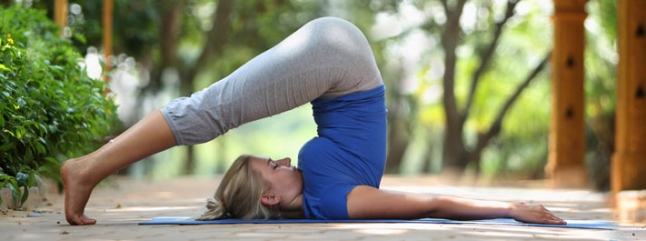
Halasana, or Plow Pose, is an inverted asana in which the legs travel overhead while the shoulders and upper arms form the base. The Sanskrit word hala means plow and asana means posture. The shape asks for gradual preparation through the shoulders, upper back, hips and back line of the legs.
The feet do not need to reach the floor for the posture to be meaningful. A chair, wall or stacked blankets can make the position steadier and help the practitioner keep pressure away from the head and neck. Learn the entry and exit with a qualified yoga teacher before attempting long holds.
Navigator
Preparation for Halasana
Begin with gentle movements rather than repeatedly rolling into the pose. Practise a comfortable supine leg raise, a supported bridge and quiet shoulder-blade movement. Keep the head centred throughout the preparation.
- Place two or three neatly folded blankets beneath the shoulders if that setup has been taught to you.
- Leave the head on the mat and create enough blanket space for the tops of the shoulders.
- Keep a chair or wall behind the head so the feet have a reachable support.
- Remove necklaces, hair clips and anything that changes the position of the head.
- Decide how you will exit before lifting the pelvis.

Halasana Steps
- Lie on the back with the legs together or hip-width apart and the arms alongside the body.
- Bend the knees toward the chest. Press the arms down and lift the pelvis without turning the head.
- Support the back with both hands. Keep the elbows no wider than the shoulders when possible.
- Guide the thighs toward the torso and lengthen the sitting bones upward.
- Extend the legs overhead only as far as the shoulders remain grounded and the breath stays smooth.
- Place the feet on a chair, wall or floor. Do not push the toes toward a surface that is not naturally reachable.
- Keep the front of the throat soft, the face relaxed and the gaze upward.
- Hold for a few ordinary breaths. Beginners can use a brief, well-supported stay.

Hand and Leg Options
Keeping the hands on the back usually offers more control. If the feet are firmly supported and the upper back feels stable, the arms may extend on the floor with the fingers interlaced. This arm position is optional; it should not pull the shoulders into a range that disturbs the neck.
The knees may remain softly bent. Straight legs are not a requirement. A chair-supported version lets the feet rest at a consistent height, while a wall-supported version allows the practitioner to choose the distance gradually.

How to Exit
- Return the hands to the back if they have been released.
- Bend the knees and bring the thighs closer to the torso.
- Press the palms into the mat and slowly roll the spine down one section at a time.
- Keep the head still until the pelvis and feet are on the floor.
- Rest on the back and allow ordinary breathing to settle.
After the pose, use a quiet neutral position such as Shavasana. Avoid immediately turning the head from side to side.
Alignment Points
- Use the shoulders and upper arms as the base rather than the back of the head.
- Keep the head centred and never look toward the legs.
- Lift through the pelvis instead of collapsing the chest toward the face.
- Let the toes rest lightly on their support.
- Choose a leg position that permits ordinary breathing.
- Keep the entry and exit slower than the hold.
Common Mistakes
- Trying to make the feet touch the floor at any cost.
- Turning the head while the body is inverted.
- Entering with momentum and losing control of the pelvis.
- Placing most of the weight on the head.
- Holding the breath or tightening the jaw.
- Staying longer after the shape begins to collapse.
Practice Limits
Halasana is not an entry-level inversion. Leave the pose if there is sharp discomfort, tingling, numbness, pressure at the head or neck, or loss of steady breathing. Do not improvise blanket height, arm variations or long holds. A teacher can help you decide whether a supported half version is the appropriate study.
Sarvangasana uses a related shoulder-supported base, but it should also be learned separately and progressively.
Frequently Asked Questions
Must the toes touch the floor?
No. Resting the feet on a chair or wall is a complete variation and often gives better control.
Should the legs stay straight?
No. Softly bent knees can reduce pulling through the back line of the legs and make the exit easier.
Where should I look?
Look upward and keep the head still from entry through exit.
I really liked this one. I have many yoga found from this. It shows yoga nicely with pics. It’s benefits are all right. I am happy.