
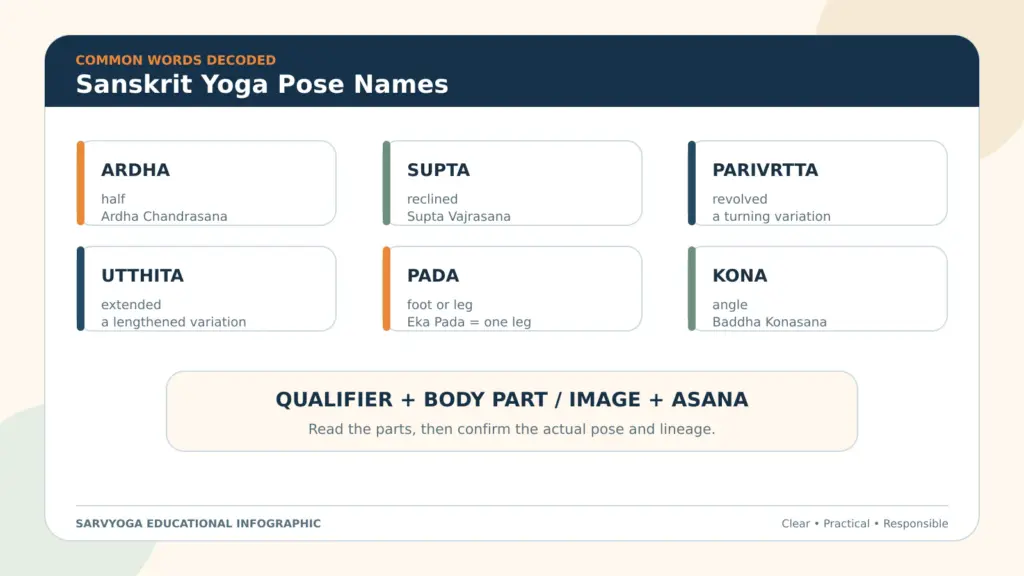
Sanskrit yoga pose names often look complex because several descriptive words are joined together. Once those parts are recognised, an unfamiliar name can reveal the pose’s direction, body position, shape or traditional reference.
This guide does not replace learning pronunciation from a knowledgeable teacher. It provides a practical reading method for students who encounter names such as Ardha Matsyendrasana, Supta Vajrasana or Utthita Trikonasana in books and classes.
Navigator
How an Asana Name Is Built
Many pose names follow a loose pattern:
qualifier + body part or image + asana
For example, Ardha Chandrasana can be separated into ardha (half), chandra (moon) and asana (posture). The English name “Half Moon Pose” follows the same structure.
Not every name translates word for word, and different lineages may use a name differently. Treat the parts as useful clues, then confirm the actual posture being taught.
The Essential Ending: Asana
Asana means a seat, posture or established position. In compound pose names, it usually appears at the end. English spellings may show a space before “asana,” join it to the previous word or use diacritical marks. SarvYoga generally uses the joined form in pose titles for consistency.
Common Direction and Position Words
- Ardha — half: Ardha Chandrasana, Half Moon Pose.
- Supta — reclined or lying down: Supta Vajrasana, Reclined Thunderbolt Pose.
- Utthita — extended: often used for a lengthened standing variation.
- Parivrtta — revolved or turned: identifies a rotational variation.
- Urdhva — upward: as in an upward-facing or upward-reaching position.
- Adho — downward: as in a downward-facing position.
- Purva — east or front side: sometimes used for the front of the body.
- Paschima — west or back side: appears in Paschimottanasana.
Number and Side Words
- Eka — one: frequently begins a one-sided or one-limbed variation.
- Dvi or Dwi — two: indicates two or both.
- Tri — three: appears in names involving three parts or angles.
- Chatur — four: appears in Chaturanga, “four-limbed.”
- Parsva or Parshva — side or flank: describes a side-facing or lateral relationship.
Transliteration varies because Sanskrit sounds can be represented in English letters in more than one way. Parsva and Parshva, for example, may refer to the same Sanskrit word.
Body-Part Words
- Pada — foot or leg: used in names involving one or both legs.
- Hasta — hand: identifies the hand or an arm-to-hand relationship.
- Janu — knee: appears in Janushirasana.
- Sirsa or Shirsha — head: the spelling changes with transliteration.
- Mukha — face: often paired with a direction such as upward or downward.
- Anga — limb or part: appears in words such as Chaturanga.
- Karna — ear: appears in postures named for the relation of the legs or knees to the ears.
Shape, Action and Relationship Words
- Kona — angle: found in Baddha Konasana.
- Baddha — bound: indicates that parts of the body are linked or held in a particular relationship.
- Danda — staff: appears in Dandasana, Staff Pose.
- Namaskara — salutation: used in Surya Namaskar and other salutation sequences.
- Uttana — intense stretch or extended: often appears in forward-bending names.
- Vritta — turned, circular or pattern: its precise sense depends on the compound.
Animals, Sages and Traditional Images
Some names describe a visible resemblance; others honour a sage, hero or traditional story.
- Bhujanga — cobra: Bhujangasana.
- Ushtra — camel: Ustrasana.
- Mayura — peacock: Mayurasana.
- Garuda — Garuda: a traditional figure whose name is used for Garudasana.
- Vira — hero or warrior: appears in Virasana and Virabhadrasana.
- Matsyendra — Matsyendra: honoured in Ardha Matsyendrasana.
A familiar English nickname may simplify the cultural reference. Learning the Sanskrit name preserves more of the original context.
A Five-Step Method for Decoding a Name
- Find the ending asana.
- Look for a direction or qualifier such as ardha, supta or parivrtta.
- Identify a body part such as pada, hasta, janu or mukha.
- Look for a shape, animal, sage or traditional image.
- Confirm the final posture with a teacher or reliable practice guide.
Take Supta Baddha Konasana: supta means reclined, baddha means bound, kona means angle and asana means posture. The compound describes a reclined form of Bound Angle Pose.
Pronunciation and Transliteration
English letters cannot represent every Sanskrit sound exactly. A long vowel may be marked with a line, and sounds written as “sh,” “s,” “ri” or “r” may vary between simplified and scholarly systems. This is why Shirshasana, Sirsasana and Śīrṣāsana can refer to the same name.
Choose one consistent spelling in your notes and listen carefully when a qualified teacher pronounces the word. Accuracy improves through repeated listening and speaking, not by rushing through a long compound.
Common Learning Mistakes
- Assuming one English spelling is the only correct transliteration.
- Translating a traditional name only from its modern visual resemblance.
- Using the same Sanskrit name for different variations without checking the lineage.
- Memorising a full list without connecting names to actual poses.
- Treating pronunciation as a test rather than a gradual study.
Teacher’s Note: Teach Names in Useful Pieces
Students remember Sanskrit more readily when a word appears in several familiar poses. After learning ardha in Ardha Chandrasana, point it out again in Ardha Matsyendrasana and Ardha Halasana. The repeated element becomes meaningful rather than remaining an isolated label.
Write the Sanskrit and English names together, then demonstrate how the words describe the version being practised. This supports language learning and clearer pose identification at the same time.
Frequently Asked Questions
Do I need to know Sanskrit to practise yoga?
No. Clear movement, breath awareness and responsible practice do not depend on memorising terminology. Sanskrit names can deepen context and make it easier to recognise related poses.
Why does one pose have several spellings?
Different transliteration systems represent Sanskrit sounds differently. Regional usage and simplified English spelling also create variations.
Why do teachers use different names for the same shape?
Yoga lineages sometimes classify or name variations differently. Ask which version is being taught and focus on its specific setup.