
Nadi Shodhana Pranayama is an alternate-nostril breathing practice. The name combines nadi, a traditional term for a channel, with shodhana, meaning cleansing or refining. In a beginner version, the nostrils are alternated gently while the breath remains smooth and free from retention.
The technique should be learned as a quiet pattern, not as a test of breath length. A supported seat, light finger contact and a short number of rounds make the sequence easier to understand.


Navigator
Meaning and Traditional Context
Nadi Shodhana belongs to the wider study of pranayama. Different teaching traditions use different counts, hand positions and stages. The version below focuses on uncomplicated alternation and natural pacing. More demanding ratios and pauses should not be added simply because they appear in another sequence.
Prepare a Comfortable Seat
- Sit on a chair or a folded blanket.
- Keep the spine upright without lifting the ribs.
- Rest the left hand on the thigh.
- Relax the jaw, tongue and shoulders.
- Observe several ordinary nasal breaths.
Siddhasana is optional. Any seat that remains steady is appropriate.
Hand Position
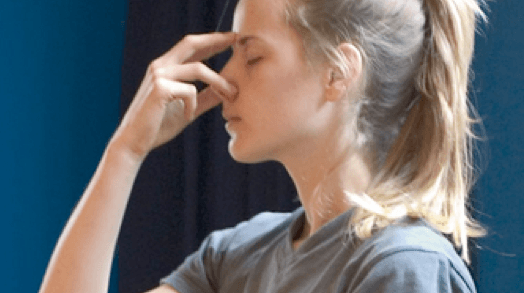
Raise the right hand. The thumb can close the right nostril and the ring finger can close the left. The index and middle fingers may fold toward the palm or rest lightly near the eyebrow centre. Keep the wrist neutral and the elbow relaxed. Only a light touch is needed to direct the airflow.
Step-by-Step Beginner Sequence
- Exhale normally through both nostrils.
- Close the right nostril and inhale through the left.
- Close the left nostril, release the right and exhale through the right.
- Inhale through the right nostril.
- Close the right nostril, release the left and exhale through the left.
- This completes one round.
- Practise three to five rounds without pausing the breath.
- Lower the hand and return to ordinary breathing.
Pacing and Breath Length
Let the breath remain quiet enough that the nostrils do not feel pulled inward. The inhalation and exhalation may be similar in length, but exact equality is not required. If a count is helpful, use a short count that leaves space at the end of every breath. There is no need to lengthen the exhalation or add retention in the introductory version.
Nadi Shodhana and Anulom Vilom
The names are sometimes used interchangeably in modern classes, while some schools distinguish the sequences or their later stages. Follow the method being taught and keep the pattern clearly defined. The separate Anulom Vilom guide explains SarvYoga’s presentation of that practice.
Useful Modifications
- Support the right elbow with the left hand or a folded blanket.
- Alternate the idea mentally while breathing through both nostrils.
- Use fewer rounds and rest the hand between them.
- Practise simple nasal breathing when one side does not feel open.
- Keep the eyes softly open when closing them reduces steadiness.
Common Mistakes
- Pressing the nostrils more firmly than necessary.
- Moving the head toward the hand.
- Lifting the shoulder and holding the elbow in the air.
- Forcing air through resistance.
- Losing track of which side begins the next breath.
- Adding long counts or breath pauses too early.
Practice Effects
The alternating pattern develops concentration, hand-breath coordination and awareness of the flow through each nostril. It can provide a clear transition from asana to seated observation. Repeating a short, familiar pattern also helps the practitioner notice when finger pressure or breath effort begins to change. These are practice observations rather than guaranteed outcomes.
Practice Limits and Teacher Guidance
Return to ordinary breathing for dizziness, unusual breathlessness, pressure or agitation. Do not force a blocked side or continue to meet a count. A qualified yoga teacher can help simplify the hand position, confirm the alternation pattern and decide when a different pranayama is more appropriate.
Frequently Asked Questions
Which side should begin?
This beginner sequence begins by inhaling through the left and finishes by exhaling through the left.
Is breath retention required?
No. Learn smooth alternation first and keep the breath continuous.
How many rounds should a beginner practise?
Three to five unforced rounds are enough for learning the pattern.
I feel numbness or tingling or feeling like needle insertion in every part of body…when i tried 20 rounds each nostrils lvl 1…is it normal? and why does this happen? I am suffering from poor digestion since long time…should i continue or not?
@Tushar, For poor digestion do kapalbhati, do the pranayam properly, in starting do 10 rounds and after that try another pranayama. Pranayama should be done systematically one by one. so please read our Pranayama section. If you feel again needle insertion then do the yogic activities under the expert person. I think your, somwhere down the line your technique is incorrect so do pranayam correctly, small mistakes harms you.
Namaste. are we supposed to complete all the 4 steps in a single session ? I’d read somewhere that each of those levels should be practiced for a few weeks before we start the following level. please guide.
@Rockie, yes you can complete all the 4 steps in a single session. but don’t do it instantly before performing this you have to master in Anulom vilom and First level of Nadi shodhana Pranayama. Once you’re comfortable you can do all the four steps in one session once in a week.
Thank you & May God bless you
keep Visiting our website for further updates.
Thank you very much, sir. You said “Once in a week”. Can’t i do it everyday ? I do Yoga everyday and want to do Nadi Shodhana too every morning. pls guide.
PS: Have been doing Anulom Vilom for a year or two.
@Rockie,
happy to see your comment again. First, perform all the breathing exercise in a systematic way. First, perform a simple version of Nadi shodhana. But if you want to do all the 4 steps then, give 5 minutes time to every step. If you want to do all the four steps every day then it will also do.if you are uncomfortable then leave it. Otherwise, carry on it is good for you.
Thank you.
may God bless you.
Thank you, sir.
God bless you.
@Rockie, always welcome.