
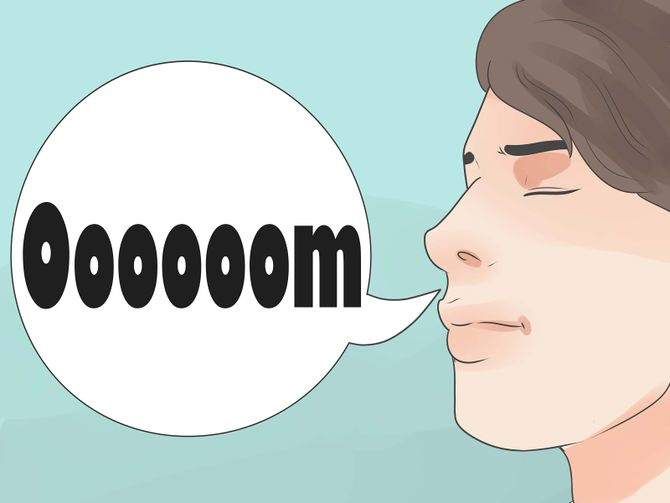
Udgeeth Pranayama is commonly taught as a steady chanting practice centred on the sound Om or Aum. The practitioner inhales comfortably, chants during an unforced exhalation and then listens as the sound fades into silence.


Navigator
What Is Udgeeth Pranayama?
Udgeeth is associated with a raised, resonant or chanted sound. In common yoga teaching, the practice uses Om as a prolonged vocal exhalation. The aim is not to produce the loudest or longest sound. The emphasis is on posture, breath, vibration, listening and a quiet pause after each repetition.
Some traditions divide the syllable into A–U–M, while others express it as one continuous sound. Follow the method of the teacher or lineage you are studying.
Prepare the Seat
- Sit on a chair, cushion or folded blanket.
- Let the pelvis feel supported and the spine rise naturally.
- Keep the chin level and the back of the neck long.
- Rest the hands on the thighs or in a simple mudra.
- Soften the jaw, tongue, throat and shoulders.
- Observe several natural breaths before chanting.
Padmasana is optional. A chair or easy cross-legged position is suitable when it supports steadiness.
Udgeeth Pranayama Steps
- Sit comfortably and become aware of the natural breath.
- Inhale through the nose without lifting the shoulders or drawing in excessive air.
- Begin the sound Om as the exhalation starts.
- Let the sound remain smooth and moderate in volume.
- Allow the lips to come together gently for the final humming portion.
- Finish the sound before the throat tightens or the breath feels empty.
- Listen for a short pause without deliberately holding the breath.
- Take the next inhalation naturally.
- Repeat three to five times.
- Finish with quiet sitting and ordinary breathing.
How to Shape the Sound
The opening part of Aum may be felt as an open vowel, followed by a rounded sound and then a gentle hum. The transition should be continuous rather than divided into three hard sections. Exact proportions vary between traditions and do not need to be measured by a beginner.
- Choose a pitch that feels natural.
- Keep the volume low enough that the throat remains relaxed.
- Let the sound shorten when the breath is shorter.
- Notice vibration without trying to create a dramatic sensation.
Listening Is Part of the Practice
Udgeeth includes both sounding and listening. After each chant, notice the fading vibration and the return of ordinary breathing. This quiet interval keeps the practice from becoming a mechanical series of repetitions.
Group chanting may create a shared rhythm, but each person should keep an individual, comfortable exhalation. There is no need to continue until every other voice stops.
Useful Modifications
- Chant softly rather than at full voice.
- Use a shorter sound and pause for a natural breath between repetitions.
- Practise the humming portion alone.
- Use silent mental repetition when vocal chanting is not appropriate.
- Sit in a chair when floor sitting distracts from the breath and sound.
Common Mistakes
- Taking an oversized inhalation before every chant.
- Forcing the sound to last as long as possible.
- Using a pitch that strains the throat.
- Pushing the chin forward or lifting it upward.
- Raising the shoulders during inhalation.
- Chanting repeatedly without listening between rounds.
- Using the length or volume of the sound as a competition.
How Long to Practise
Begin with three rounds and observe the voice, breathing and posture. Increase to five or seven rounds only while the chant stays smooth. A brief, attentive practice followed by silence is enough for beginners.
Practice Limits
Stop and return to ordinary breathing if chanting causes throat strain, dizziness, confusion or breathlessness. Avoid forcing a long exhalation. Extended mantra practice, formal ratios and combinations with retention should be learned with qualified teacher guidance.
Frequently Asked Questions
Should I chant Om or Aum?
Both spellings are used. The pronunciation and emphasis may vary by teaching tradition.
How loud should the chant be?
Use a moderate or soft voice that allows the throat, jaw and face to stay relaxed.
Must one chant last for a fixed count?
No. End the sound while it is still smooth and before the exhalation becomes strained.
Can I practise silently?
Yes. Silent mental repetition can be used when vocal practice is not suitable, though it changes the emphasis from sound production to attention.
Thank you for the information. I have friend whose 12 years son had a brain tumor sugery …can he do some yoga? if yes please tell me some.
@ Kiran, what’s the condition of your friend son after the Surgery?
You are using simple and easy to understand words. I like your simplicity. I have read some articles on your website, and that is up to the mark. Keep it up… I want more interesting articles from you.
Best of luck guys.
Good to see your comment, thanks for your precious comment. It motivates us for doing hard work. Keep connected
Thanks!
Regards: Sarvyoga Team
Nice and Detailed information.
@Shekar,
Thanks for appreciating our work. This will work as a catalyst for us and your appreciation motivates us to do more better things. Keep visiting our website.
Regards
Hi! I liked your article it is a good one without any complexity . i need a clarification that are Udgrib Pranayama and Udgheeth pranayama same thing or a different one. If they are not same thing than what is the difference between them . It will be a great help for me . i found somewhere that Udgrib Pranayama is good for ears but when i’m searching on google i’m not getting it anywhere . I got confused about this.
@Somu Roy, First of all, Happy New Year. I didn’t herd about Udgrib Pranayama. From where you read about this Pranayama. In our Website, you find all the breathing techniques in a systematic manner. Send the link of Udgrib Pranayama form where you read about this.
There are four different mudras for aa, uu, mm and om, which we need to be in and chant 07 times each. May I please, know which are those ?
to know more about mudras please visit: https://www.sarvyoga.com/yoga-mudras-miracle-of-fingers-gesture/
Hey, Thank you I just Try this and explained to us very well I feel Very Relaxed