
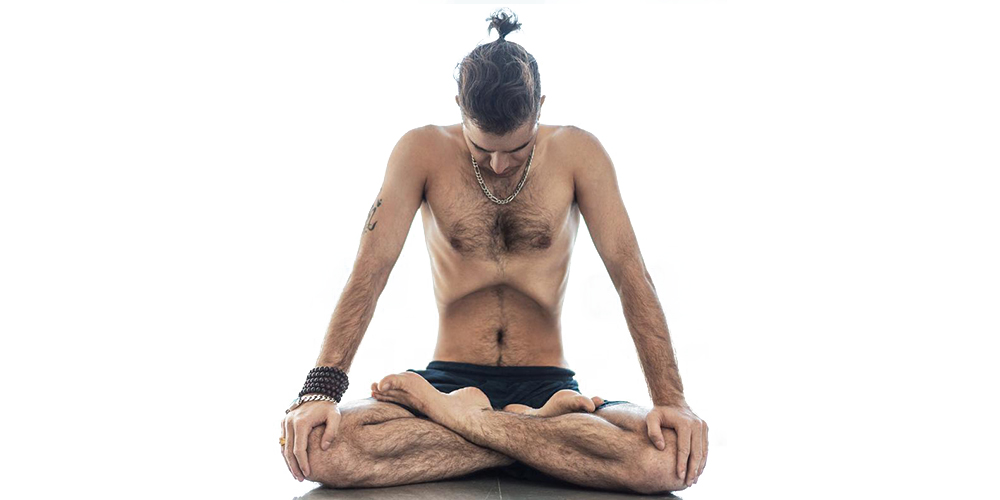
Bahya Pranayama is an advanced breathing practice involving exhalation, a pause with the breath out and, in some traditions, the coordinated use of bandha. It is not a beginner breathing exercise.
Navigator
Traditional structure
The practice is generally organised around a complete exhalation, external retention and controlled release. The details vary by school, especially when Jalandhara, Uddiyana or Mula Bandha are included.
Preparation
- Develop a stable seated posture.
- Practise ordinary breath awareness.
- Learn smooth exhalation without strain.
- Study each bandha separately with a qualified teacher.
- Keep the face, throat and shoulders relaxed.
Teacher-led learning sequence
- Sit upright and observe natural breathing.
- Exhale smoothly without collapsing the chest.
- Pause only within an easy, controlled range.
- Release any bandha before inhaling.
- Take several ordinary breaths between rounds.
Common mistakes
- Forcing the exhalation.
- Holding beyond a comfortable limit.
- Applying several bandhas without preparation.
- Inhaling before the throat and abdomen are released.
- Repeating rounds without recovery breaths.
Practice limits
Do not learn Bahya Pranayama from text alone. Stop immediately when there is pressure, dizziness, confusion, breathlessness or loss of coordination. External retention, fixed ratios and bandha should be studied directly with a qualified yoga teacher.
EXCELLENT BABA RAM DAVE, I AM WATCHING YOU SINCE THE BEGINNING YOU CAME ON THE TV YOU HAVE COMPLETELY CHANGED THE WORLD ORDER.
YOU ARE STRUGGLING HARD TO GET THE PEOPLE OF INDIA ON TRACK OF YOGA AND GET CURED FROM ALL SICKNESS.
EVEN I HAVE STARTED DOING PRANAYAMS BY GETTING UP EARLY MORNING AT 4.45 AM AND PRACTICING 45 MINUTES EVERY DAY. SUCH AS BASTRIKA 10 TIMES KAPALBATHI 1200 TIMES BAHIYA 10 TIMES ANULOM VILOM 20 TIMES AND BRAMARI AND UDGEETH 10 TIMES EACH12 MANDUK ASANAS
FOLLOWED BY HOLISTIC EXERCISES.
I AM 63 YEARS OF AGE MY WEIGHT WAS 72 KG. NOW COMEDOWN TO 65.
i HAD A COMPLAINT OF BLOOD PRESSURE AND DIABETES 2, I THING BY NOW THAT ALSO MIGHT HAVE COME DOWN/CURED.
BUT ALL ROUND FEELING HEALTHY AND LIGHT IN WEIGHT LIKE BUTTER FLY.
THANK YOU SIR,
I WISH YOU ALL THE BEST AND PRAY FOR YOUR LONG LIFE AND PROSPERITY.
@Domenic D’Souza, thnx for applauding our work. It seems like you are a lover of yoga, keep it up and May God bless you. again thnx for sharing your experience with us. Please share your knowledge with others, to make other people life happy.
Description of Bahya Pranayam is very enlightening. Please clarify the following doubts. (1) Bahya Pranayam is done with which mudra (Gyan Mudra or Vayu mudra). (2) During Bahya Pranayam, the drishti is fixed on which centre (Manipura chakra/ Anahata chakra/ Agna chakra/ or any other chakra).
@Dr.R.K.Mishra, Thank you, sir, for your precious comment. It’s good if you perform this Asana in Gyan Mudra. And the During any pranayama, if someone is beginner then at initial stage focus on your breathing. Once you are familiar with Pranayama. Then fixed your focus on Agna chakra. Or you can also focus on any Chakra it’s your choice. But Agna chakra is good for focusing during Pranayama.
Thank You! keep visiting our website.
May God Bless you.
Dear Shri Arahan Singh: Thanks for your reply. It reflects your mastery over ‘Yoga’. I hope it will of immense help to the practitioners of Bahya Pranayam. Regards, Dr RK Misra.
Thanks, sir, for appreciating our work. Your comments mean a lot to us.
it works as a catalyst for us.
Keep connected with us.
Thanks!
Regards: Sarvyoga Team
Always be happy & keep practicing.
Dear Sir,
I would like to know the ratio of inhale, hold (internal retention), exhale and hold
( external retention).
Also clarify whether retention (both internal and external) can be done without applying bandhas, will it have the same benefit.
Regards,
Parthasarathy
@ParthaSarathy,
Hope you are doing well, thanks for your valuable comment. Ratio is depend on your capacity. So, choose the inhale, exhale and hold ratio according to your comfort.
IN this Jalandhar bandh is mandate, and mula bandha is optional but its good if you apply both bandha at this breathing exercises.
Hope we our answer satisfy you, if you find any doubt then write us. We are trying our best to solve your query.
GOD BLESS YOU Keep Practicing.
Regarda Sarvyoga Team
If possible, I would love to learn Yoga from you 1 on 1 through online classes.