
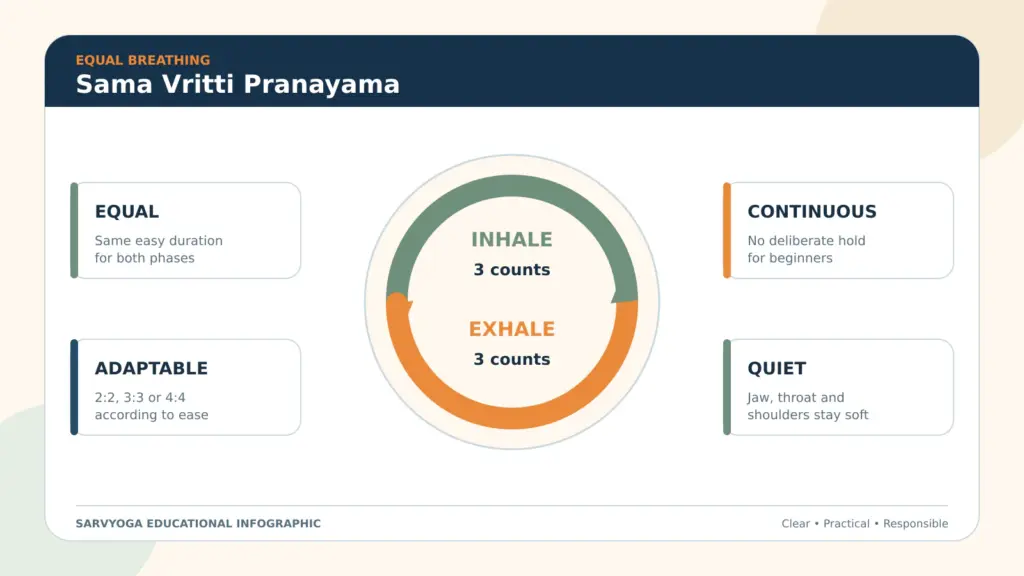
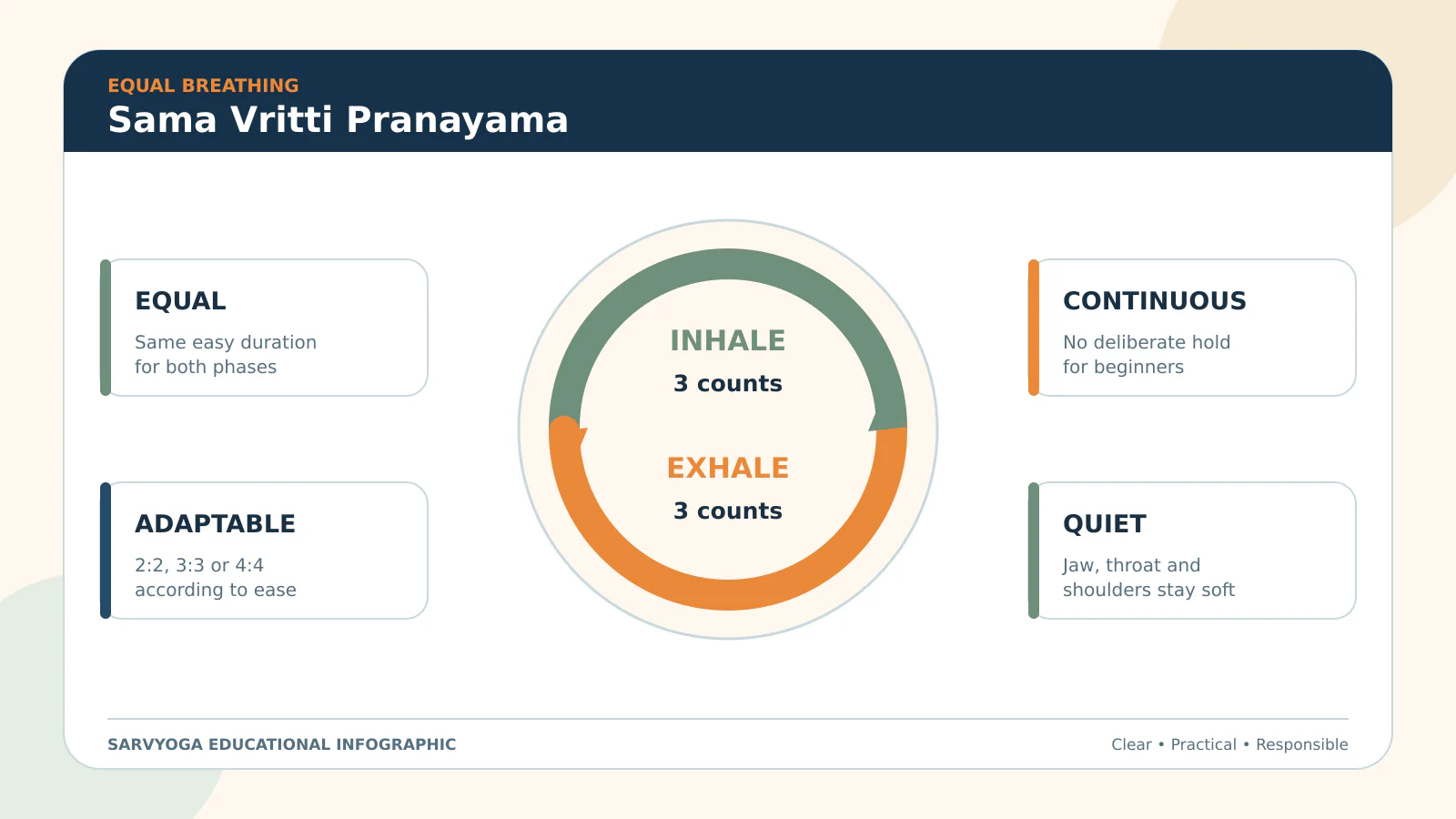
Sama Vritti Pranayama is an equal-breathing practice in which inhalation and exhalation use the same comfortable count. Sama means equal or balanced, while vritti can refer to movement, pattern or activity. The name points to an even breath pattern rather than a particular number.
The practice should begin without breath retention. A three-count inhalation and three-count exhalation may be appropriate; another practitioner may need a shorter or longer rhythm. Equality is useful only when both phases remain smooth.
Navigator
What Makes the Breath “Equal”?
The count is the same for inhalation and exhalation, but the two sensations will not be identical. Inhalation expands the torso; exhalation allows it to settle. The sound, volume and muscular activity may differ while the duration remains approximately equal.
Counting provides feedback. It should not become a target that forces the last part of a breath or creates urgency before the next cycle.
Prepare the Seat
- Use a stable chair or a supported floor seat.
- Place the feet or sitting bones evenly.
- Rest the hands and soften the jaw.
- Keep the lower ribs over the pelvis without rigidly lifting the chest.
- Observe five ordinary nasal breaths before counting.
Siddhasana is optional. The best seat is the one in which the breathing pattern can remain unforced.
Find Your Starting Count
- Count one ordinary inhalation without changing it.
- Count one ordinary exhalation.
- Choose the lower comfortable number.
- Begin with that number for both phases.
If the inhalation naturally lasts three counts and the exhalation four, begin with three in and three out. Do not extend the shorter phase merely to match a preferred count.
Step-by-Step Sama Vritti Pranayama
- Sit comfortably and observe several natural breaths.
- Inhale through the nose for a gentle count of three.
- Exhale through the nose for the same count of three.
- Begin the next inhalation without holding the breath.
- Repeat for four to six cycles.
- Release the count and return to ordinary breathing.
- Notice whether the throat, jaw, shoulders and abdomen stayed quiet.
Count at an even pace. One count is a pulse, not necessarily one second. Using the same steady mental rhythm matters more than measuring exact time.
Progression Without Force
Remain with one count for several practices. Increase only when the final count on both phases feels as clear as the first.
- Practise 3:3 for four cycles.
- Over time, increase to six cycles without changing the count.
- Then try 4:4 for only three or four cycles.
- Return to 3:3 whenever 4:4 creates effort.
Longer is not automatically better. A steady 3:3 pattern is complete when it meets the purpose of equal breathing.
Chair, Reclined and Hand-Supported Options
- Chair: support both feet and sit away from the backrest.
- Reclined: bend the knees and place the feet down; use this position to learn before returning to a seat.
- Hand contact: rest the hands on the side ribs to observe expansion without pressing.
- Open eyes: keep a soft downward gaze if closed eyes reduce steadiness.
- Short set: practise only three equal cycles, then rest.
Sama Vritti and Breath Retention
Some modern practices use the phrase “box breathing” for four equal phases: inhale, hold, exhale and hold. That is not the beginner version described here. Sama Vritti can be practised as two equal moving phases without pauses.
Breath retention changes the technique and should not be added casually. Establish posture, a comfortable count and a quiet transition between cycles before studying more advanced ratios with qualified guidance.
Sama Vritti Compared with Other Pranayama
- Dirgha Pranayama: organises awareness through regions of the torso.
- Nadi Shodhana: alternates the nostrils and may later use ratios.
- Ujjayi: uses a soft throat sound to observe continuity.
- Sama Vritti: uses equal duration as the principal learning tool.
Learn these patterns separately before combining them.
Common Mistakes
- Choosing four counts because it is common, even when three is clearer.
- Speeding up the last part of the exhalation to finish on time.
- Taking in too much air at the beginning of inhalation.
- Squeezing out all remaining air at the end of exhalation.
- Holding briefly between phases without intending to.
- Counting so loudly in the mind that the face and throat tense.
- Continuing after the breath has become urgent.
Teacher’s Note: Listen to the Last Count
The last count of each phase reveals whether the ratio fits. If it ends with strain, acceleration or a sudden stop, shorten the count. The first count should not take most of the air, and the last count should not require squeezing.
Ask the practitioner to release the method for two ordinary breaths between short sets. This makes the technique easier to compare and prevents counting from continuing automatically after clarity has been lost.
A Six-Minute Practice Outline
- Natural breathing: one minute.
- Observe the comfortable inhale and exhale counts: one minute.
- Practise four cycles at 3:3 or another suitable count.
- Return to natural breathing for one minute.
- Repeat four equal cycles if the first set remained clear.
- Finish without counting and observe the breath.
Practice Limits
Stop counting and return to ordinary breathing for dizziness, tingling, pressure, breath hunger, agitation or unusual discomfort. Do not use a timer to push a longer ratio. A qualified yoga teacher can help select posture, pacing and progression.
Frequently Asked Questions
What count should a beginner use?
Use the shortest count that fits both phases comfortably. Two, three or four may all be appropriate starting points.
Should the inhale and exhale use the same amount of air?
The duration is approximately equal; the sensations and volume do not need to feel identical.
Is breath retention required?
No. A beginner can study Sama Vritti through equal inhalation and exhalation with no deliberate pause.