
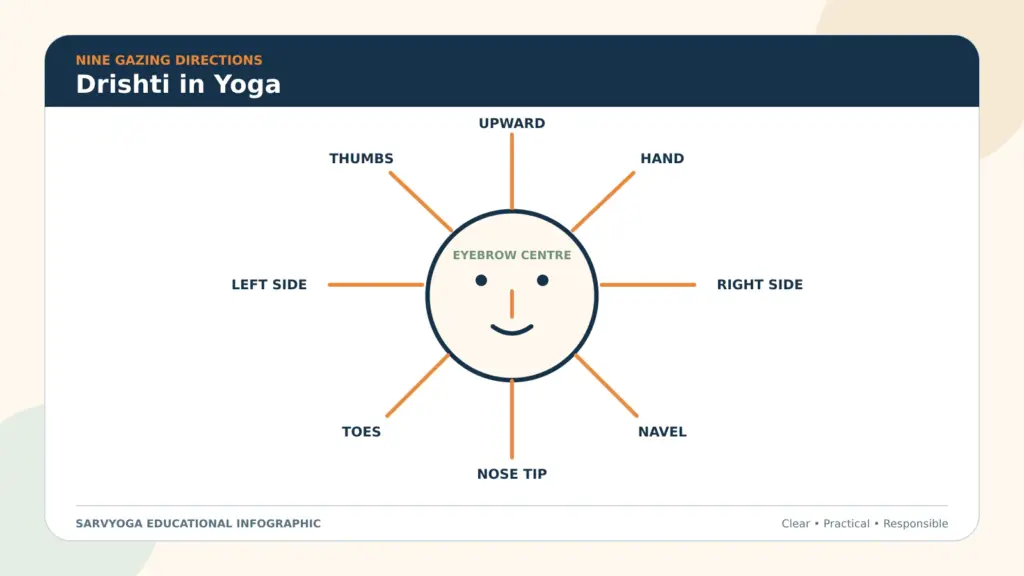
Drishti in yoga means a view, sight or focused direction of the gaze. In practice, it gives the eyes a clear place to rest and the attention a steady reference. Drishti is most familiar in Ashtanga Vinyasa Yoga, where particular gazing directions are associated with different postures, but the wider principle also appears in balance, pranayama and meditation instruction.
A Drishti is not a hard stare. The eyes remain receptive, the face stays relaxed and the chosen point can be adapted when orientation, balance or comfort requires another option.
Navigator
Drishti as More Than Eye Position
The Sanskrit root drish relates to seeing. A physical gazing point is the most visible aspect of Drishti, yet its purpose is attentional: reducing unnecessary visual movement and connecting the eyes with the direction of the pose.
Different schools use the term in different ways. The following nine-point system is commonly taught in the Ashtanga Vinyasa tradition. It should not be presented as the only Drishti system used throughout yoga.
The Nine Common Drishti Directions
- Nasagrai or Nasikagra Drishti — tip of the nose: the gaze moves gently toward the nose without crossing or straining the eyes.
- Bhrumadhya Drishti — eyebrow centre: the direction is toward the space between the eyebrows.
- Nabhi Chakra Drishti — navel: the gaze follows the front of the body toward the navel area.
- Hastagrai Drishti — hand: the eyes rest toward the hand or fingertips.
- Padayoragrai Drishti — toes: the gaze is directed toward the feet or toes.
- Angusthamadhya Drishti — thumbs: the eyes rest toward the thumbs, often when the arms reach overhead.
- Urdhva or Antara Drishti — upward: the gaze moves into the space above.
- Parsva Drishti, right — right side: the eyes look laterally toward the right.
- Parsva Drishti, left — left side: the eyes look laterally toward the left.
Spellings vary in English. A teacher may use shortened forms or a different transliteration while referring to the same direction.
How to Use a Soft Gaze
- Choose a point that can be seen without moving the head out of alignment.
- Let the eyelids and muscles around the eyes remain relaxed.
- See the point clearly but allow peripheral vision to remain available.
- Keep the breath natural.
- Look away and blink normally whenever the eyes feel dry or over-focused.
The gaze does not need to be held continuously. Re-establish it after checking foot placement, props or the teacher’s demonstration.
Drishti in Standing Balance
A stable point in front is often more useful for balance than the traditional point named for a final pose. In Vrikshasana, begin with a fixed point at eye level. If balance remains clear, explore a different direction later.
This is an example of adapting the gaze to the learning stage. The practitioner first needs orientation and a reliable base. A more demanding Drishti should not be added merely because it appears in a complete version of the posture.
Drishti in Standing and Seated Asana
- Hand gaze: in Trikonasana, the gaze may move to the upper hand, forward or down according to balance and neck comfort.
- Thumb gaze: when the arms rise in Tadasana, the thumbs can provide a clear upward direction without throwing the head back.
- Toe gaze: in a seated forward bend, looking toward the feet can continue the direction of the torso, but the neck should remain easy.
- Side gaze: in a twist, the eyes may follow the rotation only as far as the neck can move comfortably.
- Navel gaze: in a rounded position, looking toward the torso can help the head follow the curve without hanging.
Drishti in Pranayama and Meditation
Some seated practices use a downward gaze, the tip of the nose or the eyebrow centre. Beginners can instead keep the eyes softly open and look toward the floor several feet ahead. Closed eyes are another option when the seated base and orientation remain steady.
Do not combine an unfamiliar internal gaze with a demanding breathing technique. Learn one attentional element at a time and return to a neutral gaze between rounds. The SarvYoga pranayama guide explains how to begin from posture and natural breath.
A Short Drishti Practice
- Sit or stand comfortably and choose a point at eye level.
- Rest the gaze there for three natural breaths.
- Without moving the head, shift the eyes gently to the right and back to centre.
- Shift gently to the left and return.
- Look toward one hand, then relax the eyes and blink.
- Finish with a broad, receptive view of the room.
This exercise introduces direction without attempting all nine points in one session.
Common Mistakes
- Staring intensely and forgetting to blink.
- Moving the head or neck farther than the posture supports.
- Using a challenging upward gaze before balance is stable.
- Crossing the eyes forcefully for the nose-tip or eyebrow-centre direction.
- Treating one lineage’s Drishti assignment as universal.
- Continuing after the gaze becomes uncomfortable or disorienting.
Teacher’s Note: Separate Head Position from Eye Direction
Students often move the whole head when asked to change the gaze. First establish the neck position, then ask the eyes to travel only within an easy range. In balance poses, give a stable forward option before introducing a traditional upward or hand-focused Drishti.
A useful gaze supports the pose; it does not make the pose look more advanced. When the eyes become tense, widen the field of vision or return to a neutral point.
Practice Limits
Release the technique for eye strain, headache, dizziness, blurred focus or loss of orientation. Look ahead, blink and return to ordinary visual activity. Keep the eyes open during balance practice when closing them reduces stability. A qualified yoga teacher can help select a gaze that matches the posture and learning stage.
Frequently Asked Questions
Is Drishti the same as Trataka?
No. Drishti is a gazing direction used within yoga practice. Trataka is a distinct yogic gazing practice with its own setup and limits.
Must the eyes stay open?
Not always. Many seated practices allow closed eyes. In standing balance, an open, stable gaze is usually the clearer starting point.
Do all yoga styles use the same nine points?
No. The nine-point list is particularly associated with Ashtanga Vinyasa teaching. Other traditions may use different gaze instructions.