
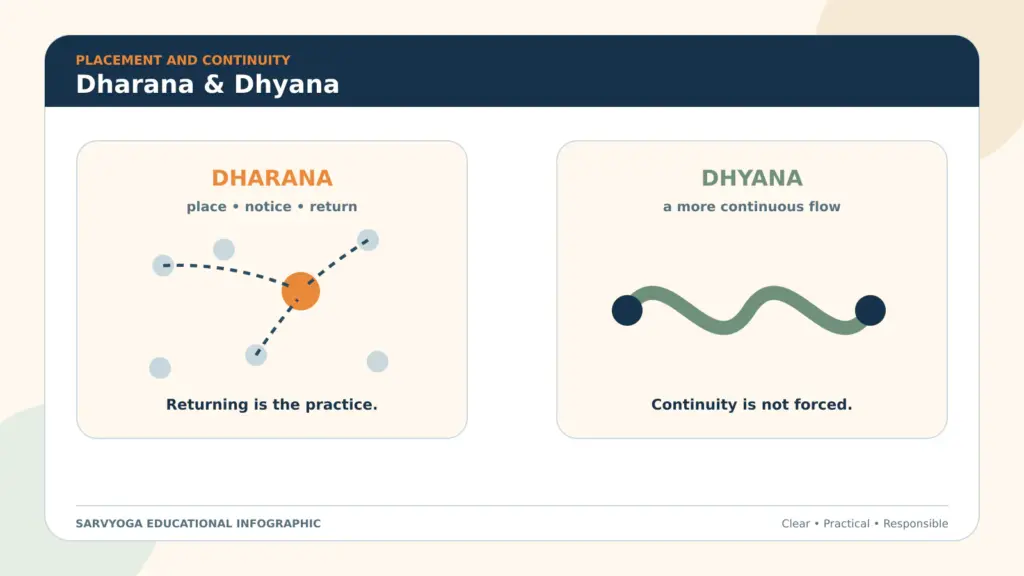
Dharana and Dhyana are the sixth and seventh limbs in Patanjali’s eight-limbed yoga. Dharana is commonly translated as concentration: placing attention within a chosen field. Dhyana is meditation: a more continuous flow of attention toward that object.
The difference is not simply that Dharana lasts for a few minutes and Dhyana lasts longer. It concerns the quality and continuity of attention. During Dharana, attention may wander and be deliberately returned. Dhyana describes a steadier relationship in which interruptions become less prominent.
Navigator
Traditional Definitions in Practical Language
Yoga Sutra III.1 describes Dharana as binding or placing the mind in a chosen place. Yoga Sutra III.2 describes Dhyana as the continuity of cognition or attention there. These are paraphrases; translations use different English terms.
The “place” may be a physical point, a sound, the breath, a visual form, a mantra or another object specified by the tradition. The important feature is that the object is deliberately chosen rather than constantly replaced.
Dharana: Placing and Returning Attention
Dharana includes the active skill of returning. The practitioner notices that attention has moved, releases the new object and places attention back on the original one.
- The object is clearly defined.
- Distraction is recognised.
- Attention is returned without adding a second struggle.
- The process repeats as often as needed.
Successful Dharana is not the absence of every distraction. Recognising distraction and returning is the practice.
Dhyana: A More Continuous Flow
In Dhyana, attention is less frequently rebuilt. The relationship with the object becomes more continuous, and competing impressions do not interrupt in the same way. This continuity cannot be forced by staring harder, tightening the body or refusing to acknowledge distraction.
Dhyana may emerge from well-established Dharana. It is not a performance that can be claimed simply because a timer has completed.
Dharana and Dhyana Compared
- Dharana: attention is intentionally placed on one field.
- Dhyana: attention flows more continuously in relation to that field.
- Dharana: returning is clearly felt as a repeated action.
- Dhyana: the need to return becomes less prominent.
- Dharana: effort may be noticeable but should remain proportionate.
- Dhyana: continuity becomes steadier without increased force.
These descriptions are learning markers, not a test for assigning a label to every seated session.
Prepare Posture Before Choosing an Object
A stable posture reduces unnecessary decisions. Sit on a chair or use enough height beneath the pelvis. Let the hands rest, the head balance and the breath remain natural.
Siddhasana is one traditional seat, but no particular floor position is required for learning concentration. A chair is appropriate when it provides a clearer base.
Practice 1: Breath as the Field
- Choose one location where the natural breath is easy to feel.
- Observe one complete inhalation and one complete exhalation.
- When attention moves elsewhere, name the movement quietly as “thinking,” “sound” or “sensation.”
- Release the label and return to the chosen breath location.
- Continue for three to five minutes.
Do not alter the breath to make the object stronger. The task is to return to the selected field as it changes naturally.
Practice 2: Sound as the Field
- Choose a simple repeated sound, a gently spoken mantra learned within an appropriate context or the natural sound of breathing.
- Attend to the beginning, middle and end of each repetition.
- Notice the brief interval before the next repetition.
- Return when attention shifts to another sound or thought.
- Finish with one minute of ordinary listening.
Om and Aum chanting has its own traditional meaning and method; study that context rather than using the sound as a generic tool.
Practice 3: A Visual Point
Use a plain, stable point on the wall. Let the gaze remain soft, blink normally and keep peripheral vision available. Each time the eyes or attention leave, return gently. Close the practice by looking around the room and resting the eyes.
This is a simple concentration exercise. Trataka is a distinct yogic practice and should be learned with its specific setup and limits.
What Happens When Thoughts Appear?
Thoughts are not proof that practice has failed. A thought becomes a distraction when it replaces the chosen object and attention follows its sequence. Notice the shift, avoid analysing it during the session and return.
If one concern repeatedly captures attention, write it down after practice. The note acknowledges that it may require action without making the concentration period responsible for solving it.
Progression from Dharana toward Dhyana
- Use the same object for several sessions.
- Keep the posture and duration realistic.
- Reduce unnecessary changes in technique.
- Notice whether returns become simpler and less argumentative.
- Observe periods of continuity without trying to hold them.
- Finish while the posture and attention are still clear.
Changing objects frequently can make practice interesting, but it gives less opportunity to understand one attentional relationship in depth.
Common Obstacles
- Dullness: the object becomes vague and attention loses brightness.
- Restlessness: attention moves rapidly between impressions.
- Over-effort: the brow, jaw, breath or posture becomes rigid.
- Under-preparation: an unstable seat creates repeated physical adjustment.
- Object switching: the practice changes whenever difficulty appears.
- Evaluation: the session becomes a continuous judgment of whether meditation is happening.
Respond with practical changes: open the eyes, shorten the duration, improve support, clarify the object or return another day.
Teacher’s Note: Make the Object Precise
“Focus on the breath” can be too broad. Ask the student to choose the movement of the lower ribs, the contact of air at the nostrils or the complete cycle. A precise field makes wandering easier to recognise and returning easier to perform.
Do not promise Dhyana as the result of a fixed number of minutes. Teach the actions that support Dharana, and describe continuity without turning it into an achievement to grasp.
A Seven-Minute Beginner Outline
- Establish posture and orientation: one minute.
- Observe natural breath without selecting a point: one minute.
- Choose one breath location and practise returning: three minutes.
- Release the object and observe the whole field: one minute.
- Open the eyes, move and finish: one minute.
Practice Limits
Stop and reorient for dizziness, distress, loss of orientation or unusual discomfort. Keep the eyes open and use a stable external point when inward attention is unclear. Meditation should not be forced through an unstable posture or overwhelming experience. Qualified guidance is appropriate when the practice is unfamiliar.
Frequently Asked Questions
Is Dharana the same as mindfulness?
The terms come from different systems and should not be treated as exact synonyms. Dharana specifically refers to placing attention within a chosen field in the classical yoga framework.
How long does Dharana take to become Dhyana?
There is no universal time threshold. The distinction concerns continuity and quality of attention rather than minutes completed.
Can I practise with a chair?
Yes. A stable chair can provide a clearer base than a floor posture that requires continuous adjustment.