
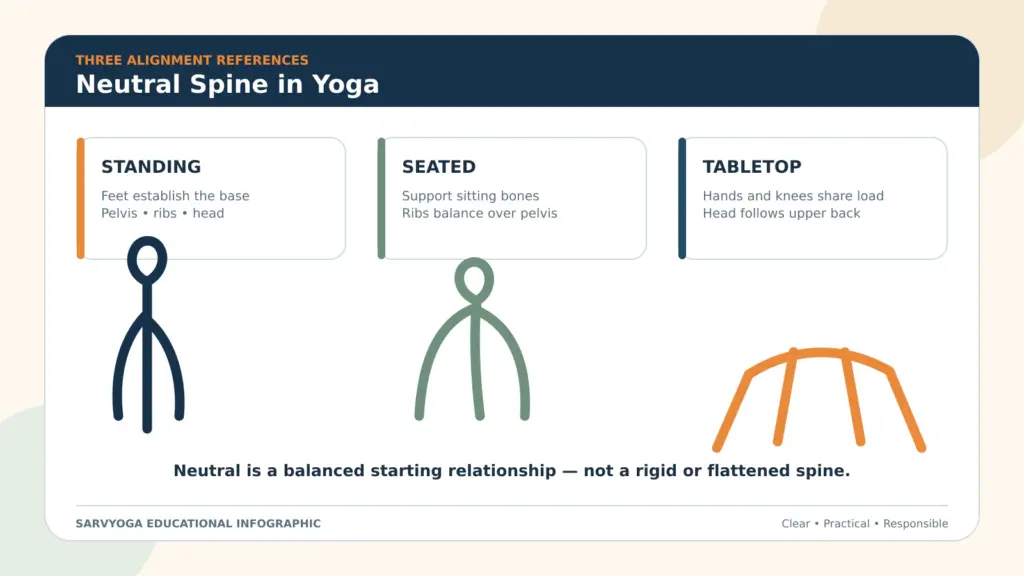
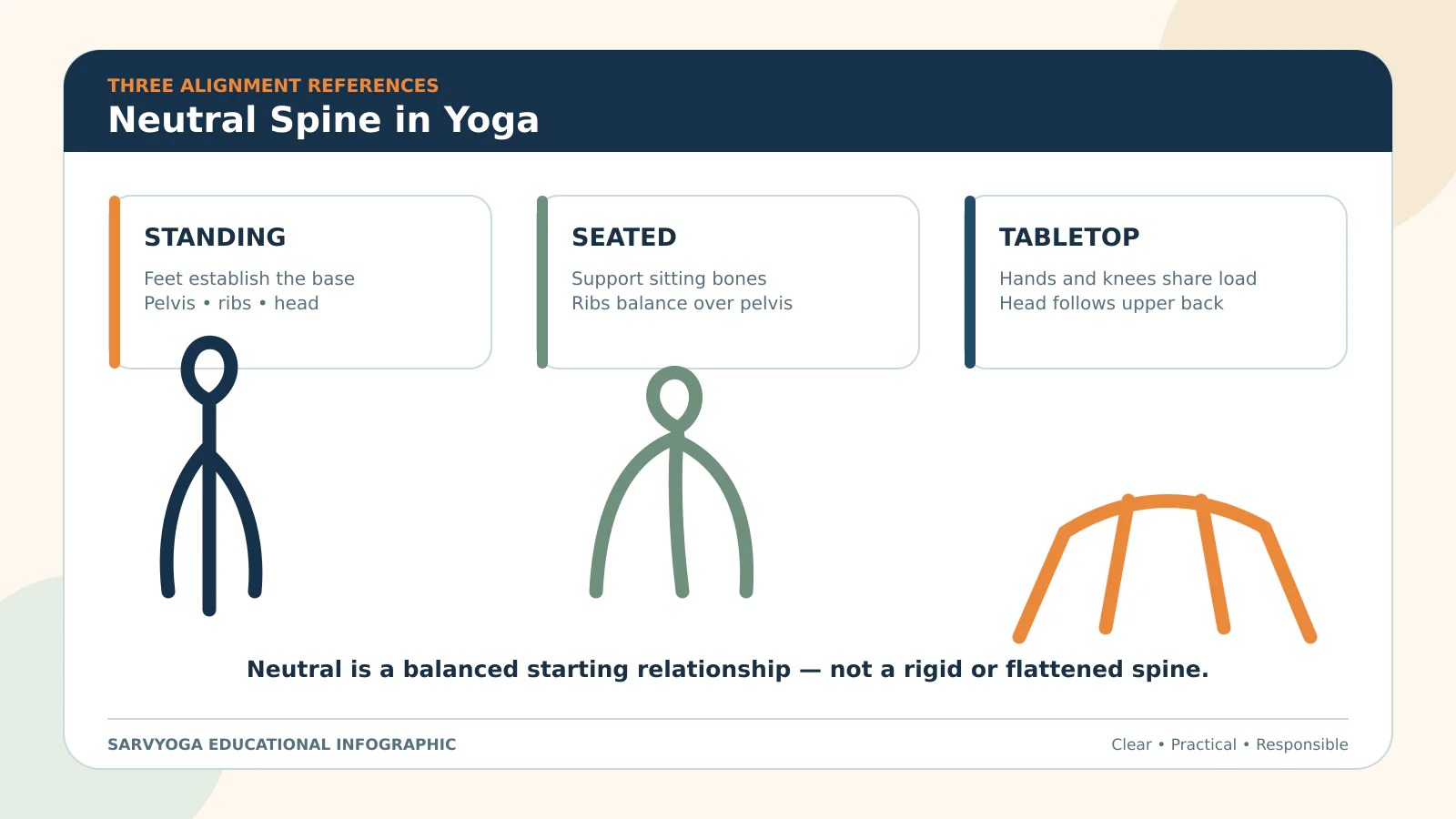
Neutral spine in yoga describes a balanced relationship between the pelvis, rib cage and head. It is not a perfectly straight back and it is not one fixed position that every practitioner must reproduce. The spine has natural curves, and neutral alignment preserves those curves without exaggerating or suppressing them.
This idea is useful in Tadasana, Dandasana, tabletop and many other starting positions. It gives the practitioner a clear reference before flexing, extending, rotating or side-bending the spine. The reference must still be adapted to the pose, the person and the support available.
Navigator
Neutral Does Not Mean Flat
Viewed from the side, the spine normally includes inward curves at the neck and lower back and an outward curve through the upper back. A useful neutral position keeps these curves organised while the surrounding muscles provide appropriate support. Trying to flatten every curve can create as much unnecessary effort as over-arching.
Neutral also changes with orientation. Standing, sitting and bearing weight through the hands each alter the effect of gravity. The goal is not to make the three shapes look identical. The goal is to maintain a clear relationship between the main landmarks.
Three Landmarks to Observe
- Pelvis: notice whether the front of the pelvis tips markedly forward or rolls backward.
- Rib cage: let the lower front ribs rest over the pelvis instead of lifting ahead of it.
- Head: balance the ears over the shoulders without pushing the chin forward or pulling it sharply down.
These are observations, not commands to brace. A quiet breath should still move through the torso. If an alignment cue makes breathing restricted, reduce the effort and reconsider the support.
Finding Neutral Spine in Tadasana
- Stand with the feet together or hip-width apart, choosing the base that feels steadier.
- Distribute weight across the heels, the base of the big toes and the base of the little toes.
- Bend and straighten the knees once, then leave them extended without locking them back.
- Rock the pelvis gently forward and backward through a small range.
- Pause near the middle, where the lower back feels long but not flattened.
- Let the lower ribs settle over the pelvis.
- Lengthen through the crown of the head and keep the gaze level.
- Observe three to five natural breaths without hardening the abdomen.
The result may feel quieter than a dramatic “chest up, shoulders back” posture. Compare it with the alignment guidance in Tadasana.
Finding Neutral Spine in a Seated Pose
Sitting often makes the pelvis roll backward, especially when the knees remain higher than the hips. Place a folded blanket beneath the sitting bones before trying to lift the spine with muscular effort.
- Sit in a simple cross-legged position, Siddhasana, Dandasana or on a chair.
- Feel the two sitting bones and balance weight between them.
- Move the pelvis slightly forward and backward to locate a stable middle position.
- Place the rib cage above the pelvis rather than pulling the shoulders behind it.
- Let the hands rest where the shoulders can remain quiet.
- Keep the back of the neck long and the gaze soft.
If the posture requires constant effort, increase the seat height or choose a chair. A supported position is more useful than holding a low seat with a rounded back and strained breath.
Finding Neutral Spine in Tabletop
- Come onto hands and knees, with the wrists under or slightly ahead of the shoulders.
- Place the knees beneath the hips and spread the fingers comfortably.
- Move once through Marjariasana and Bitilasana.
- Return toward the midpoint between the rounded and arched positions.
- Keep the back of the head in line with the upper back and look toward the mat.
- Press the floor evenly without forcing the shoulder blades apart.
- Take several natural breaths and notice whether the lower back changes unnecessarily.
A folded blanket under the knees and yoga wedges beneath the hands can make the reference position clearer. If the wrists are uncomfortable, use fists, blocks at the wall or a chair-supported tabletop.
How Neutral Spine Changes in Other Poses
Neutral is a starting reference, not a rule that prevents movement. In a forward bend, the spine and pelvis may move into flexion. In a backbend, they move into extension. In a twist, rotation is distributed through the available parts of the spine. Knowing the starting relationship helps the practitioner recognise where the movement begins and whether one area is doing all the work.
- Hip hinges: in a standing half-fold, the pelvis moves over the thighs while the spine stays relatively long.
- Supported backbends: the extension is shared rather than concentrated only in the lower back.
- Twists: first establish length, then rotate without forcing the pelvis and shoulders into opposite extremes.
- Balances: a neutral reference can organise the torso, but the spine may adjust to keep the centre of weight over the base.
Common Alignment Errors
- Flattening the lower back by gripping the abdomen and tucking the pelvis strongly.
- Lifting the front ribs while trying to appear upright.
- Pulling the shoulders back so firmly that the neck tightens.
- Forcing the chin down instead of balancing the head.
- Using the same cue in every posture and for every practitioner.
- Holding the breath while maintaining the shape.
Useful Modifications and Props
- Stand with the back near a wall to compare the pelvis, ribs and head without pressing every point flat.
- Sit on enough blanket height for the pelvis to balance naturally.
- Use a chair when a floor seat makes the spine round.
- Place blocks under the hands in a standing half-fold.
- Move tabletop to a wall or chair to reduce weight through the wrists.
- Shorten the time in the position and repeat after a pause.
Teacher’s Note: Use Cues as Questions
An experienced teacher does not treat “neutral spine” as a photograph. A more useful approach is to ask what changed after a cue: Did the breath become quieter? Did the base become steadier? Did one region stop gripping while another began to participate? These observations show whether the cue fits the practitioner.
Words such as “tuck,” “arch,” “lift” and “draw back” can be useful in a specific situation, but they should not become permanent instructions. Explore a small range, locate the clearest middle position and then compare it during movement.
A Short Neutral-Spine Practice
- Stand in Tadasana for five breaths.
- Move between Cat and Cow Pose for four slow rounds.
- Pause in tabletop neutral for three breaths.
- Sit on a folded blanket in Dandasana or a simple cross-legged seat.
- Compare pelvic balance and rib position for five breaths.
- Finish in a comfortable resting position.
This sequence is for alignment study, not for achieving one “perfect” posture. Stop or change the position for sharp discomfort, numbness, tingling or restricted breathing.
Frequently Asked Questions
Should the lower back touch a wall in neutral spine?
Not necessarily. The lower back normally has an inward curve. Use the wall as a reference for organisation, not as a surface against which every spinal curve must be pressed.
Should the abdomen be pulled in?
A light, responsive abdominal tone may support the position, but hard gripping can disturb breathing and flatten the spine. The torso should remain able to move with a natural breath.
Is neutral spine required in every yoga pose?
No. Many asanas deliberately flex, extend, rotate or side-bend the spine. Neutral provides a reference before and after those movements.