
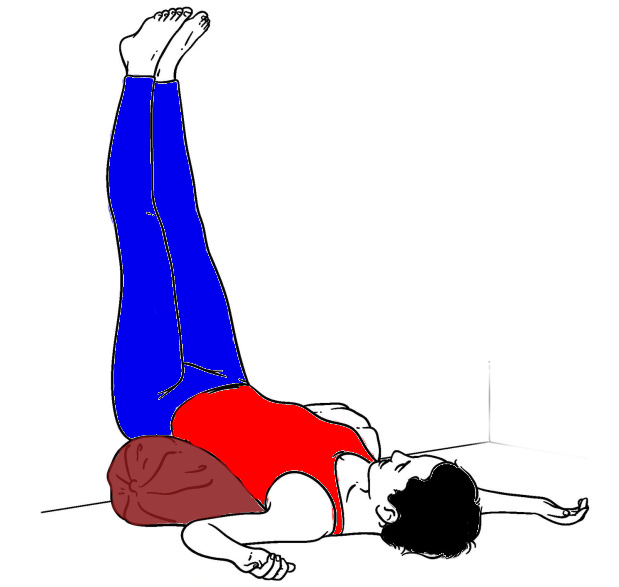
Viparita Karani is commonly practised as Legs Up the Wall Pose. The Sanskrit name combines viparita, meaning inverted or reversed, with karani, meaning action. In modern asana classes, the name usually describes a supported supine position with the legs resting vertically or diagonally against a wall.
The pelvis may stay on the floor or rest on a low folded blanket or bolster. The distance from the wall determines the angle at the hips and knees. A comfortable setup matters more than making the legs completely straight.


Navigator
Arrange the Wall Space
Choose a clear wall with enough floor space to turn safely. Place a mat perpendicular to the wall. Keep a folded blanket for the head and another support for the pelvis if desired.
- Start without pelvic elevation until the wall distance is clear.
- Keep the support low and stable.
- Remove objects that could interfere with turning or exiting.
- Wear clothing that allows the legs to move freely.
- Decide which side you will roll toward when leaving.
Step-by-Step Wall Version
- Sit sideways near the wall with one hip pointing toward it.
- Lower onto one forearm and then onto the back as the legs swing upward.
- Adjust the pelvis farther from the wall until the legs can rest without pulling.
- Support the head with a thin folded blanket when the chin lifts.
- Place the arms beside the body, on the abdomen or in a comfortable open position.
- Keep the knees straight, softly bent or supported by a strap loop when useful.
- Let the breath remain natural and the face relaxed.
- Stay for a short period that feels steady and easy to exit.
- Bend the knees, place the feet on the wall and roll to one side.
- Pause on the side before pressing up to sit.
Wall Distance and Leg Options
Move farther from the wall when the back of the legs feels strongly pulled or the pelvis curls upward. The knees may bend, and the feet can rest lower on the wall. Moving slightly closer creates a more vertical leg position, but only when the pelvis remains grounded and easy.
Other options include placing the soles together with the knees opening gently, taking the feet wider apart, or resting the calves on a chair. Change one element at a time and return to the simplest version before exiting.
Using a Bolster or Folded Blanket
A low support beneath the back of the pelvis can create a mild elevated variation. Position it before entering. The support should sit under the sacral area rather than the lower ribs, and the pelvis should feel stable rather than tipped.
If the support makes the lower back feel compressed or the breath less comfortable, remove it and practise with the pelvis on the floor. More height does not make the posture more complete.
Comfortable Alignment
- Keep the back of the head and shoulders evenly supported.
- Allow the pelvis to settle rather than pressing it toward the wall.
- Use soft knees whenever straight legs create strain.
- Let the feet remain neutral instead of holding a strong point or flex.
- Rest the hands where the shoulders can release.
- Keep enough space to roll to the side during the exit.
Common Mistakes
- Placing the pelvis too close to the wall.
- Using a high bolster before learning the floor version.
- Forcing the knees straight.
- Staying after the feet become numb or the lower back loses ease.
- Turning the exit into a quick sit-up.
- Adding unfamiliar leg positions during a long hold.
Practice Effects
Viparita Karani offers a supported way to study inversion, wall contact and quiet supine alignment. It can develop awareness of how wall distance changes the pelvis and legs. The chair and bent-knee variations make the same orientation available with less demand on the back of the legs.
Practice Limits
Exit if there is sharp discomfort, tingling, numbness, pressure in the head or eyes, or difficulty breathing freely. Keep the pelvis on the floor and shorten the stay whenever support height creates uncertainty. A qualified yoga teacher can help with wall distance and prop placement.
Frequently Asked Questions
Must the pelvis touch the wall?
No. Most practitioners need some distance so the pelvis can rest naturally.
Must the legs stay straight?
No. Soft knees, feet lower on the wall or calves on a chair are all useful options.
How should I exit?
Bend the knees, roll to one side, pause and then press up with the hands.