
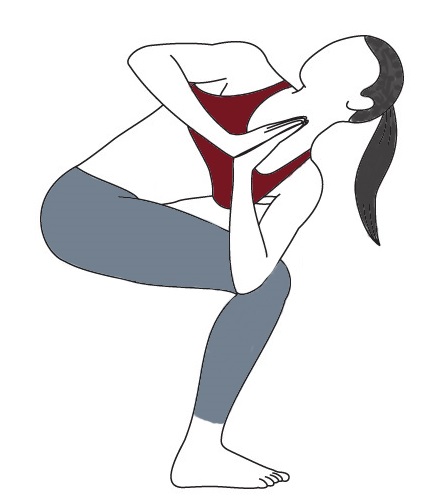
Parivrtta Utkatasana, commonly called Revolved Chair Pose or Twisted Chair Pose, combines a standing squat with rotation. It asks the legs to support the pelvis while the spine lengthens and the chest turns.
The twist does not need to be deep. Keeping the hands apart, using a wall or standing more upright can make the pose easier to organise and reduce strain through the knees, shoulders and lower back.
Navigator
Build a Stable Chair Pose First
- Stand with the feet together or hip-width apart.
- Bend the knees only as far as the heels stay grounded.
- Shift the hips back as though sitting toward a chair.
- Keep the knees tracking generally in the direction of the toes.
- Maintain length through the spine without lifting the ribs sharply.
Step-by-Step Parivrtta Utkatasana
- Begin in a comfortable Chair Pose with the hands at the chest.
- Inhale to lengthen the spine.
- Exhale and rotate the rib cage gently to the right.
- Keep both knees pointing forward rather than allowing one to move ahead.
- Place the left hand on the outside of the right thigh or keep both hands separated.
- Press the palms together only if the shoulders and wrists remain comfortable.
- Keep the neck aligned with the chest and gaze forward or slightly downward.
- Take one or two easy breaths.
- Return to the centre while keeping the legs steady.
- Stand upright, rest, and repeat on the other side.
Wall, Chair and Open-Twist Modifications
- Stand with the hips lightly touching a wall.
- Use an actual chair behind the pelvis as a height reference.
- Keep the torso more upright and bend the knees less.
- Place one hand on the opposite thigh and the other on the hip.
- Use an open twist without pressing the elbow outside the knee.
- Practise a standing twist with straight legs when squatting is not appropriate.
Knee, Pelvis and Spinal Alignment
- Distribute weight through both feet.
- Keep the knees at a similar depth rather than letting one slide forward.
- Lengthen the spine before rotating.
- Rotate through the ribs and upper back instead of pulling through the arms.
- Keep the lower abdomen gently supportive.
- Reduce the squat depth if the knees or lower back feel compressed.
Common Mistakes
- Twisting before establishing a stable Chair Pose.
- Letting one knee move noticeably ahead of the other.
- Pulling against the thigh or knee to force rotation.
- Collapsing the chest and rounding the lower back.
- Turning the head farther than the upper body.
- Holding the breath or staying after the legs lose support.
Possible Practice Effects
A well-scaled version may develop awareness of leg strength, standing balance, thoracic rotation and coordination between the pelvis and rib cage. These are practice possibilities, not guaranteed therapeutic outcomes.
Precautions and When to Modify
- Use a shallower squat or wall support with knee, hip, ankle or lower-back sensitivity.
- Avoid forceful closed twisting after recent abdominal or spinal surgery.
- Pregnant practitioners should avoid abdominal compression and use a teacher-guided open twist.
- People with dizziness, uncontrolled blood-pressure concerns or reduced balance need individual guidance.
- Stop for sharp pain, numbness, tingling, headache or unusual breathlessness.
Frequently Asked Questions
Must the feet be together?
No. Hip-width feet can provide a more stable base and make knee alignment easier to observe.
Should the elbow cross the knee?
No. The hands can remain separated and the twist can stay small. Crossing the elbow is optional.
Why does one knee move forward?
The pelvis may be rotating with the chest. Reduce the twist, use a wall and keep both feet evenly grounded.
Related SarvYoga Guides
Practice Summary
Work within a comfortable range. Stop for sharp pain, numbness, tingling, dizziness or unusual breathlessness, and seek qualified guidance when symptoms persist or individual modification is needed.