
Anjaneyasana, commonly called Low Lunge, places one foot forward with the opposite knee supported on the mat. The name refers to Anjaneya, another name for Hanuman in the Ramayana tradition. In modern asana practice, the posture is used to study a split stance, upright balance and the relationship between the pelvis, legs and spine.
The depth of the lunge is less important than a stable base. A folded blanket beneath the back knee, blocks beneath the hands and a smaller distance between the feet can make the pose clearer and easier to organise.
Navigator
Preparation
Begin with movements that prepare the ankles, knees, hips and shoulders. Useful choices include Utkatasana, Adho Mukha Svanasana and a comfortable kneeling position such as Virasana.
- Place a folded blanket near the back of the mat for the kneeling leg.
- Keep two blocks beside the front foot.
- Practise stepping one foot forward from hands and knees.
- Use a wall or chair when balance needs more support.
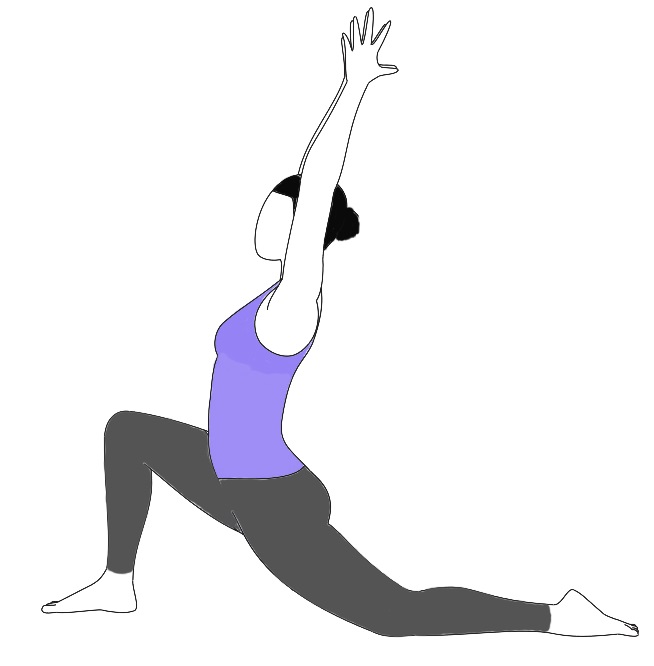
Anjaneyasana Steps
- Start on hands and knees or in Downward-Facing Dog.
- Step the right foot between the hands. Move the foot with your hand if it does not arrive in one step.
- Lower the left knee onto a folded blanket and point the left toes back.
- Place the hands on blocks and bring the torso upright gradually.
- Keep the right knee broadly above the right ankle. Move the foot forward if the knee travels far beyond it.
- Draw the legs gently toward each other without moving them. This creates a more stable base.
- Lift through the sides of the waist and keep the front ribs organised over the pelvis.
- Rest the hands on the front thigh or raise the arms if the shoulders remain easy.
- Stay for several ordinary breaths.
- Bring the hands to the floor, shift the hips back and return to hands and knees.
- Repeat on the left side.
Pelvis and Leg Alignment
The front knee and toes generally point in the same direction. Press the front heel and the top of the back foot into their supports. Instead of pushing the pelvis down, lengthen the back thigh behind you and lift the lower abdomen gently.
The pelvis does not need to face perfectly forward. Allow enough width between the feet for balance. A narrow, tightrope-like stance often makes the posture less stable.
Arm Variations
- Hands on blocks: keeps the torso inclined and makes balance easier.
- Hands on the front thigh: supports an upright torso without loading the shoulders.
- Arms alongside the ears: adds an overhead reach while the ribs remain controlled.
- Hands at the hips: helps the practitioner observe pelvic position.
- Chair support: place one or both hands on a chair beside the front leg.
Modifications
Shorten the stance when the front knee or back thigh feels overworked. Keep the torso leaning forward with the hands on blocks rather than forcing an upright position. A second folded blanket can add cushioning beneath the back knee. If kneeling is not comfortable, practise a high-lunge variation with the back knee lifted and one hand at a wall.
Common Mistakes
- Placing the feet on one narrow line and wobbling from side to side.
- Letting the front knee fall inward.
- Pushing the pelvis forward without lengthening the back leg.
- Arching the lower back in order to lift the arms.
- Shrugging the shoulders toward the ears.
- Holding the breath while trying to balance.
- Moving quickly out of the pose before the hands are supported.
Practice Effects
Anjaneyasana gives practitioners a clear way to study hip extension in the back leg, ankle and knee organisation in the front leg, and upright balance. The arm variations can also introduce overhead movement while the legs remain grounded. These are practice observations rather than guaranteed outcomes.
Practice Limits
Use a smaller range or leave the posture if there is sharp discomfort, unstable pressure at either knee, or difficulty maintaining balance. Keep the back knee cushioned and do not force the pelvis downward. More demanding versions—such as deep backbending, strong quadriceps holds or long high-lunge stays—belong in teacher-led study.
Frequently Asked Questions
Does the front knee have to form an exact right angle?
No. Use a position in which the whole front foot stays grounded and the knee tracks steadily with the toes.
Can the hands remain on blocks?
Yes. Blocks are a complete version and often improve balance and breathing.
What can follow Low Lunge?
A standing sequence may continue toward Virabhadrasana, while a gentler sequence can return to hands and knees.
Is it safe to do Anjaneyasana (Low Lunge Pose) for anterior pelvic tilt, I fear that it might stretch my hamstrings also.