
Hanumanasana, commonly called Monkey Pose or the yoga splits, is an advanced seated posture named after Hanuman. The practice develops gradually through steady preparation, balanced use of both legs and careful placement of the pelvis.
The pelvis does not need to reach the floor. Blocks, a bolster and a softly bent front knee can make the posture organised, stable and suitable for progressive yoga practice.

Navigator
Meaning and Practice Focus
Hanumanasana uses a long forward-and-back leg position. The central practice is maintaining control, an even breath and a clear relationship between the front leg, back leg and pelvis.
Prepare the Hips and Legs
- Begin with several comfortable rounds of low lunge.
- Practise a gentle half split with the hands on blocks.
- Keep a folded blanket beneath the back knee.
- Place a bolster or stacked blocks beneath the pelvis.
- Use a non-slip surface and move slowly.
Half-Split Preparation
- Begin in a low lunge with the back knee supported.
- Place both hands on blocks.
- Move the pelvis backward while keeping the spine long.
- Extend the front leg only to a controllable range.
- Keep the front knee softly bent when needed.
- Return to the lunge before changing sides.
Supported Hanumanasana Steps
- Begin from a low lunge with a block beneath each hand.
- Place a bolster or stacked blocks beneath the pelvis.
- Slide the front heel forward a small distance.
- Move the back knee backward while keeping support beneath the pelvis.
- Keep the front knee bent as much as needed.
- Lengthen upward through the trunk before exploring more range.
- Keep the breath smooth and the hands supported.
- To exit, press into the blocks, bend the front knee and return slowly.
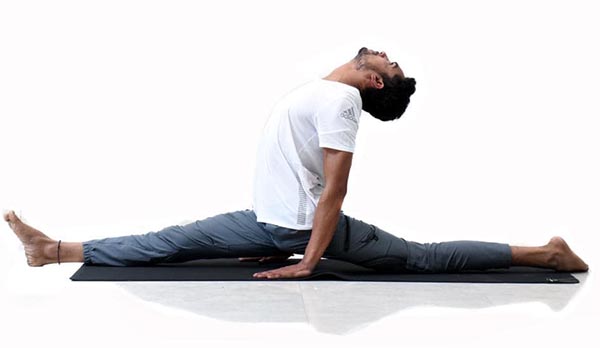
Blocks, Bolster and Bent-Knee Modifications
- Raise the pelvis on a bolster or firm blocks.
- Keep the front knee bent.
- Use a shorter distance between the feet.
- Keep the back toes tucked for additional control.
- Practise only the half-split stage.
- Use a wall or sturdy chair to support balance.
Pelvic and Leg Alignment
- Keep the front kneecap generally facing upward.
- Allow the pelvis to remain elevated and naturally angled.
- Keep the back leg aligned rather than turning it outward.
- Lengthen the trunk instead of folding heavily over the front leg.
- Press evenly through the supporting hands and props.
- Use a smaller range whenever control or breathing becomes uneven.
Common Mistakes
- Trying to reach the floor before establishing support.
- Forcing the front knee straight.
- Sliding quickly on a smooth surface.
- Turning the back leg outward.
- Collapsing the trunk forward.
- Holding the breath while moving deeper.
What the Pose Teaches
A supported Hanumanasana practice can teach patience, even use of both legs, awareness of pelvic position and control through a gradually increasing range. The quality of the setup is more important than the depth of the split.
When to Choose a Modification
- Use a higher support when the pelvis cannot remain steady.
- Keep the front knee bent when the leg cannot extend smoothly.
- Return to half split when the breath becomes uneven.
- Use a shorter stance when balance becomes uncertain.
- Learn the unsupported version directly from a qualified yoga teacher.
Frequently Asked Questions
Must the pelvis reach the floor?
No. An elevated, supported pelvis is a complete and useful variation.
Should the front knee stay completely straight?
No. A soft bend can help maintain control and an even breath.
Is Hanumanasana suitable for beginners?
The full posture is advanced. Beginners can practise supported lunges and half splits as preparation.
Related SarvYoga Guides
Practice Summary
Use props, move gradually and keep the breath natural. A supported variation is a complete yoga practice. Learn advanced versions with a qualified yoga teacher.