
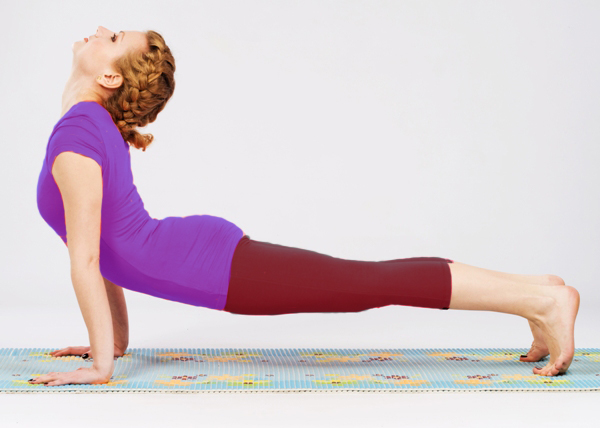
Urdhva Mukha Svanasana, or Upward-Facing Dog Pose, is a prone backbend supported by the hands and the tops of the feet. The Sanskrit name combines urdhva mukha, meaning upward-facing, with svana, meaning dog. The legs and arms lift the thighs and pelvis away from the floor.
Upward-Facing Dog is often confused with Bhujangasana, or Cobra Pose. In Cobra, the pelvis and usually part of the lower ribs remain grounded. In Upward-Facing Dog, the arms are straighter and the lower body is actively lifted. Learn the distinction before using the pose in a flowing sequence.

Navigator
Prepare the Wrists, Shoulders and Legs
Begin on hands and knees. Spread the fingers and notice even contact through the palms. Move the shoulders gently over and behind the wrists. Then lie on the abdomen and extend the legs straight back.
- Practise a low Cobra with little pressure in the hands.
- Press the tops of the feet down and activate the thighs.
- Draw the shoulder blades slightly toward the back ribs.
- Keep two blocks available for a supported version.
- Warm the spine through small, controlled movements.
Urdhva Mukha Svanasana Steps
- Lie prone with the legs extended and the tops of the feet on the mat.
- Place the palms beside the lower ribs, fingers pointing forward.
- Draw the elbows toward the torso and broaden the collarbones.
- Press the tops of the feet and thighs down as the chest begins to move forward and up.
- Straighten the arms only as far as the shoulders remain away from the ears.
- Lift the thighs and pelvis from the floor through the action of the legs and arms.
- Keep the chest moving forward rather than compressing the lower back.
- Look forward or slightly upward without throwing the head back.
- Take one or more smooth breaths according to experience.
- Bend the elbows and lower with control, or move into the next pose of a teacher-led sequence.
Block-Supported Variation
Place one stable block under each hand at its lowest setting. The extra height can create more space for the legs and pelvis to lift. Make sure the blocks are on a firm surface and cannot slide.
Another option is to keep the knees lightly grounded while learning the forward-and-upward movement of the chest. This resembles a supported transition between Cobra and full Upward-Facing Dog.
Cobra and Upward-Facing Dog
Cobra is usually the clearer starting point because the lower body stays grounded and the arms may remain bent. Upward-Facing Dog asks for stronger leg action and more weight-bearing through the hands. Do not straighten the arms merely to change the name of the pose.
Practise both shapes separately. Notice whether the chest can move forward, the neck can stay long and the breath can remain ordinary.
Alignment Cues
- Press through the full surface of each palm.
- Keep the elbows pointing generally backward during the lift.
- Activate the legs from the feet through the thighs.
- Move the breastbone forward and upward.
- Broaden the shoulders and keep them away from the ears.
- Choose a gaze that keeps the back of the neck long.
Common Mistakes
- Placing the hands too far forward.
- Straightening the arms before the legs are active.
- Letting the shoulders rise around the ears.
- Dropping the pelvis while calling the shape Upward-Facing Dog.
- Throwing the head back.
- Holding the breath or staying after the lower back loses ease.
Practice Effects
The pose coordinates arm support, active legs and spinal extension. It teaches the practitioner to distribute effort across the whole body instead of placing it only in the lower back. The block and knee-supported versions help isolate these actions.
Practice Limits
Lower immediately if there is sharp discomfort, tingling, numbness, unstable wrist pressure or pinching in the lower back. Choose Cobra, use blocks or keep the knees grounded when the full lift is not steady. Learn repeated transitions from a qualified yoga teacher before adding speed.
Frequently Asked Questions
Should the thighs touch the floor?
In full Upward-Facing Dog, the thighs and pelvis lift. If they remain grounded, practise the shape as a Cobra variation.
Must the arms be completely straight?
No. Keep a small bend when straight arms disturb the shoulders or lower back.
Where should I look?
Look forward or slightly upward while keeping the neck long.