
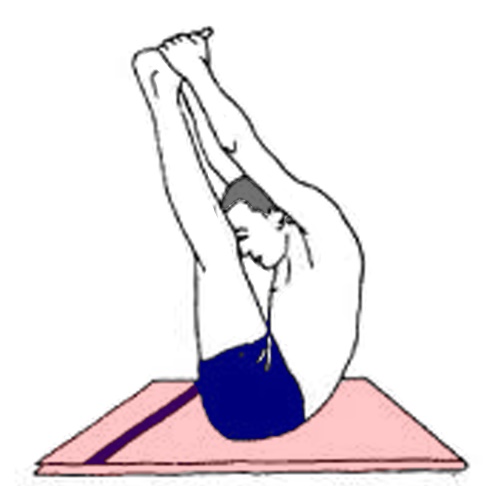
Urdhva Mukha Paschimottanasana is a seated balance in which the legs lift toward the face while the practitioner maintains an upright or gently lengthened spine. The pose combines hamstring mobility, hip flexion, abdominal control and balance.
The useful objective is not to pull the feet as close to the head as possible. A bent-knee or strap-supported version is often the better way to learn the relationship between the pelvis, spine and legs.
Navigator
Prepare the Hamstrings and Seated Balance
- Sit on a folded blanket if the pelvis rolls backward.
- Practise Dandasana with both knees slightly bent.
- Use a strap around one foot and extend one leg at a time.
- Practise a low Boat Pose with the hands behind the thighs.
- Keep the chest lifted without hardening the neck or jaw.
Step-by-Step Urdhva Mukha Paschimottanasana
- Sit with the knees bent and the feet on the floor.
- Hold the backs of the thighs or place a strap around both feet.
- Lean back only enough to balance behind the sitting bones, not on the tailbone.
- Lift one foot and then the other while keeping the knees bent.
- Lengthen the spine and broaden the collarbones.
- Extend the legs only as far as the spine can remain organised and the breath stays smooth.
- Keep the shoulders away from the ears and the gaze forward.
- Take one to three comfortable breaths.
- Bend the knees, place the feet down and return upright slowly.
Strap and Bent-Knee Modifications
- Keep both knees bent and hold behind the thighs.
- Place a strap around the balls of both feet and keep the elbows soft.
- Extend one leg while the other foot remains on the floor.
- Rest the heels on a wall and practise spinal length without balancing.
- Use a folded blanket under the sitting bones.
- Choose ordinary seated forward-fold preparation when balancing is not appropriate.
Breathing and Alignment
- Inhale to lengthen from the pelvis through the crown of the head.
- Exhale without rounding forcefully toward the legs.
- Keep the lower abdomen gently supportive rather than gripping.
- Let the shoulders remain broad and relaxed.
- Distribute the balance across the sitting bones rather than collapsing onto the tailbone.
- Stop extending the knees when the spine begins to round sharply.
Common Mistakes
- Locking the knees and pulling strongly through the arms.
- Balancing on the tailbone with the chest collapsed.
- Holding the breath to maintain the shape.
- Throwing the head forward to imitate greater depth.
- Using momentum to lift both legs.
- Ignoring hamstring, hip or lower-back pain.
Possible Practice Effects
A scaled version may develop seated balance, awareness of hip flexion, hamstring mobility and coordination between the trunk and legs. These are general practice possibilities, not guaranteed therapeutic outcomes.
Precautions and When to Modify
- Use a bent-knee or wall-supported version with hamstring or lower-back sensitivity.
- Avoid forceful pulling after recent hip, hamstring, abdominal or spinal injury.
- People with balance difficulties should practise near stable support.
- Pregnant practitioners should avoid strong abdominal compression and choose individually appropriate alternatives.
- Stop for sharp pain, numbness, tingling or dizziness.
Frequently Asked Questions
Must the knees be straight?
No. Bent knees can help the pelvis remain upright and reduce strain through the hamstrings and lower back.
Can I use a strap?
Yes. A strap can reduce pulling through the shoulders and make the leg position easier to control.
Is this a beginner pose?
It is generally an intermediate balance. Beginners can learn the components separately with bent knees and support.
Related SarvYoga Guides
Practice Summary
Use a comfortable range, stop for sharp pain, numbness, tingling, dizziness or unusual breathlessness, and seek qualified instruction when a posture is advanced or symptoms persist.