
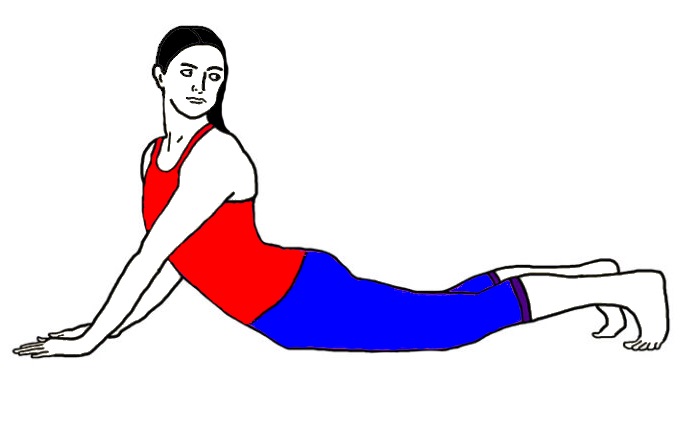
Tiryaka Bhujangasana is commonly translated as Twisting Cobra Pose or Swaying Cobra Pose. It begins from a prone cobra-like position and adds controlled rotation through the upper body. Methods vary across yoga traditions: some keep the legs together with the tops of the feet grounded, while others separate the feet and tuck the toes.
This guide uses a gentle, non-forceful version. The movement should remain small enough that the pelvis stays supported, the breath remains steady and the lower back does not feel compressed.
Navigator
Tiryaka Bhujangasana and Its Variations
The word tiryaka suggests a sideways or oblique direction. In practice, the head, chest and upper trunk turn to one side from a low or moderate cobra. It is not necessary to look all the way toward the opposite heel.
- Low-cobra variation: the elbows remain bent and the chest lifts only slightly.
- Moderate-cobra variation: the chest rises higher while the pelvis remains grounded.
- Swaying variation: the gaze moves from one side to the other without holding for long.
- Toe-tucked variation: some traditions separate the feet and rest on the balls of the feet. Learn this version directly from a teacher.
Build a Gentle Cobra Foundation
- Lie on the abdomen with the forehead down and the legs in a comfortable position.
- Place the palms beside the lower ribs or slightly in front of the shoulders.
- Point the elbows backward and relax the shoulders away from the ears.
- Press the pelvis and tops of the feet gently into the mat.
- On an inhalation, lengthen the chest forward and lift only to a height that does not pinch the lower back.
- Keep some bend in the elbows so the back muscles share the work with the arms.
Step-by-Step Twisting Cobra Practice
- Begin in a comfortable low cobra and look forward.
- Keep the pelvis heavy and the front of the body long.
- Exhale and turn the head, shoulders and upper chest gently toward the right.
- Look toward the side of the mat rather than forcing the gaze behind you.
- Inhale back to the centre.
- Exhale and repeat toward the left.
- Move slowly for two or three rounds, or hold each side for one easy breath.
- Return to the centre, lower the chest and rest with the head turned to one side.
Low Cobra and Sphinx Modifications
- Keep the forearms on the floor in Sphinx Pose and rotate only the head and upper chest slightly.
- Place a folded blanket beneath the lower ribs for a smaller lift.
- Move the hands farther forward to reduce the depth of the backbend.
- Keep the gaze forward if turning the neck is uncomfortable.
- Practise only the cobra foundation and omit the twist.
- Rest between sides instead of moving continuously.
Breathing and Alignment
- Inhale to lengthen or return to the centre; exhale into the gentle turn.
- Keep the lower abdomen lightly supportive without hard bracing.
- Let the shoulder blades move down the back rather than squeezing them together.
- Avoid straightening the elbows if this pushes the chest too high.
- Turn through the upper back and rib area rather than cranking the neck.
- Keep the movement symmetrical and comfortable on both sides.
Common Mistakes
- Using the arms to force a high cobra.
- Letting the shoulders rise toward the ears.
- Twisting mainly through the neck while the chest stays fixed.
- Lifting or rolling the pelvis away from the floor.
- Holding the breath during the turn.
- Trying to see the opposite foot regardless of comfort.
Possible Practice Benefits
A carefully taught variation may develop awareness of prone backbending, upper-back rotation, shoulder organisation and coordinated breathing. These are practice possibilities rather than guaranteed health outcomes.
Tiryaka Bhujangasana should not be presented as a treatment for spinal, digestive, endocrine or internal-organ conditions.
Precautions and When to Avoid
- Avoid the pose during current wrist, shoulder, neck or back pain.
- Do not use a deep variation after recent abdominal or spinal surgery without individual professional guidance.
- Practitioners who are pregnant should use a non-prone alternative.
- People with dizziness or sensitivity to head turning should keep the gaze neutral.
- Stop for sharp pain, tingling, numbness, nausea or unusual shortness of breath.
Frequently Asked Questions
Must the arms be straight?
No. Bent elbows usually make it easier to lengthen the spine and control the turn.
Should I hold my breath while twisting?
No. Use smooth breathing and make the movement smaller if the breath becomes strained.
Is Tiryaka Bhujangasana the same as ordinary Cobra Pose?
It uses a cobra-like foundation but adds a sideways turn. The amount of lift and the foot position may vary by tradition.
Related SarvYoga Guides
Safety Reference
The National Center for Complementary and Integrative Health advises practising yoga properly with qualified guidance and notes that some people may need individual instruction or modifications. See Yoga: Effectiveness and Safety.