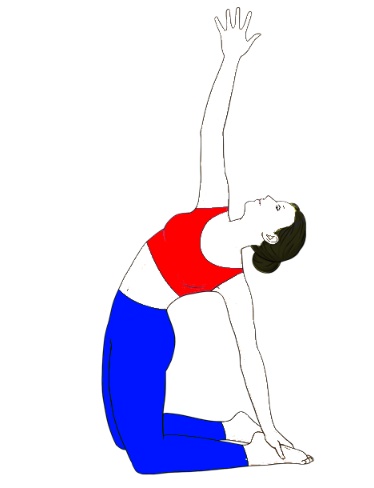
Parivrtta Ustrasana, or Revolved Camel Pose, combines kneeling, spinal extension and rotation. The exact arm position varies between yoga traditions. Because the pose can place substantial demand on the knees, lower back, shoulders and balance, it should be learned with direct guidance from a qualified yoga teacher.
This is an advanced backbend and twist. A written guide cannot assess whether the movement is appropriate for an individual body.
Navigator
Prerequisites Before the Full Pose
- Comfortable kneeling with support under the knees.
- A steady, pain-free Ustrasana preparation without collapsing into the lower back.
- Controlled upper-back rotation without forcing the neck.
- The ability to keep the pelvis organised while moving one arm.
- Confidence returning upright slowly without dizziness.
Teacher-Led Progression
- Kneel on a folded mat with the knees and feet placed comfortably.
- Keep the hands on the pelvis and practise a small upright chest lift.
- Maintain length through the lower back rather than pushing the hips far forward.
- Place one hand on a block beside the heel or keep it on the pelvis.
- Rotate gradually through the upper back while the opposite arm reaches upward or back only as far as the shoulder remains comfortable.
- Keep the gaze forward or sideways instead of dropping the head.
- Stay for one or two natural breaths under supervision.
- Return the torso to centre before changing sides or sitting back.
Safer Modification Options
- Keep both hands on the pelvis and practise only a small chest lift.
- Use blocks beside the heels so the lower hand does not have to reach far.
- Practise an upright kneeling twist without the backbend.
- Place a chair behind the body for orientation and support under teacher guidance.
- Keep the toes tucked if it makes the heel easier to reach without collapsing.
Alignment and Breathing
- Keep the knees comfortable and avoid forcing them into a fixed width.
- Lengthen upward before adding rotation.
- Distribute the backbend through the upper back rather than hinging sharply at the waist.
- Keep the abdomen and breath comfortable.
- Use a neutral neck position whenever looking back causes compression or dizziness.
Common Mistakes
- Attempting the twist before basic Camel Pose preparation is stable.
- Pushing the pelvis forward while collapsing the lower back.
- Dropping the head without neck control.
- Forcing the hand to the heel.
- Holding the breath or rushing the return to upright.
Possible Practice Benefits
With qualified instruction, the pose may challenge kneeling stability, upper-back mobility, shoulder awareness and coordination between extension and rotation. The modified upright twist or ordinary Camel preparation may provide a more suitable practice for many people.
Use the pose to study kneeling stability, spinal extension and controlled rotation rather than health outcomes.
Precautions and When to Avoid
- Avoid the full pose when there is current knee, back, neck, shoulder or wrist pain.
- Seek personalised guidance after recent surgery or injury involving the spine, abdomen, pelvis or knees.
- People affected by dizziness, balance problems or blood-pressure-related symptoms need an individually appropriate alternative.
- Pregnant practitioners should use pregnancy-specific professional guidance and avoid unsupported deep backbends and twists.
- Stop immediately for sharp pain, numbness, visual disturbance, dizziness or loss of balance.
Frequently Asked Questions
Must the lower hand reach the heel?
No. Use a block or keep the hand on the pelvis. Reaching the heel is not the purpose of the pose.
Should I drop the head back?
No. Keep the neck neutral or only move it within a comfortable, controlled range.
Can beginners practise this pose?
Beginners should use simpler kneeling chest-lift and upright twist preparations with a teacher rather than attempting the full revolved backbend.
Related SarvYoga Guides
Safety Reference
The National Center for Complementary and Integrative Health advises practising yoga properly with qualified guidance. It also notes that children, pregnant people, older adults and people with health conditions may need individual instruction or modifications. See Yoga: Effectiveness and Safety.