
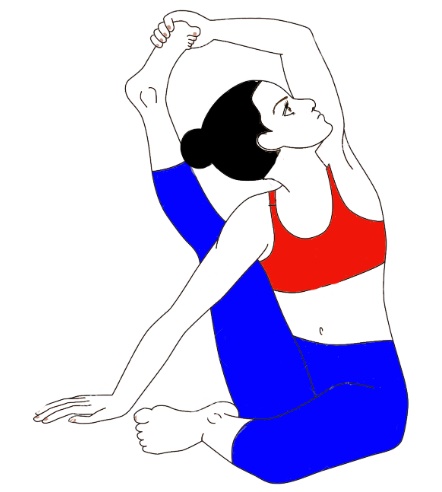
Parivrtta Surya Yantrasana, commonly called Compass Pose, is an advanced seated posture combining hip rotation, hamstring length, side bending, shoulder positioning and balance.
The lifted leg does not need to straighten fully. A bent-knee version, strap-supported version or preparatory pose is often the more appropriate practice.
Navigator
Preparatory Shapes Before Compass Pose
- Practise a comfortable seated side bend.
- Explore hamstring work with a strap while lying on the back.
- Practise Baddha Konasana with supported knees.
- Use a seated leg cradle without pulling the knee.
- Warm the shoulders gently without forcing the arm behind the leg.
Step-by-Step Supported Compass Pose
- Sit on a folded blanket with both legs comfortable.
- Bend the right knee and draw the leg toward the torso without forcing it behind the shoulder.
- Place the right hand on the floor inside the right leg.
- Hold the outside of the right foot with the left hand, or loop a strap around the foot.
- Keep the right knee bent while lengthening the spine.
- Press the right arm gently against the inner leg for support.
- Begin extending the right leg only while the knee, hip, hamstring and shoulder remain comfortable.
- Reach the left arm overhead without collapsing the right side of the torso.
- Take one easy breath, then bend the knee and release slowly.
- Repeat on the other side only when both sides are suitable.
Strap, Bent-Knee and Seated Modifications
- Keep the lifted knee deeply bent.
- Use a strap around the lifted foot.
- Hold behind the thigh instead of the foot.
- Keep the upper hand on the hip.
- Sit higher on folded blankets.
- Practise only the leg-cradle preparation.
- Use a supine hamstring stretch as an alternative.
Hip, Knee, Hamstring and Shoulder Alignment
- Do not pull the bent knee behind the shoulder.
- Keep space through the front of the shoulder.
- Lengthen the spine before side bending.
- Allow the lifted knee to remain bent.
- Stop when the hamstring sensation becomes sharp or localised near the sitting bone.
- Avoid twisting the supporting knee or collapsing through the wrist.
Common Mistakes
- Trying to straighten the leg before establishing a stable seat.
- Pulling aggressively on the foot.
- Forcing the knee behind the shoulder.
- Collapsing the torso onto the supporting hand.
- Holding the breath.
- Ignoring tingling, numbness or joint pain.
- Using the pose to claim internal-organ or digestive effects.
Possible Practice Effects
A suitably modified version may develop coordination between the seated pelvis, hamstrings, shoulders and side body. These are practice possibilities rather than guaranteed health outcomes.
Precautions and When to Avoid the Full Pose
- Avoid the full shape with current shoulder, wrist, hip, knee, hamstring, spinal or lower-back injury.
- Do not force the pose after hamstring strain or shoulder instability.
- Use qualified teacher guidance before attempting the advanced version.
- Stop for sharp pain, numbness, tingling or loss of joint control.
- Choose preparatory poses when the breath becomes strained.
Frequently Asked Questions
Must the lifted leg become straight?
No. A bent-knee, strap-supported version is complete and often more appropriate.
Should the leg move behind the shoulder?
Not by force. The leg can remain in front of the shoulder while the preparatory actions are learned.
Is Compass Pose suitable for beginners?
The full pose is advanced. Beginners should work with preparatory movements and qualified instruction.
Related SarvYoga Guides
Practice Summary
Use a comfortable range and stop for sharp pain, numbness, tingling, dizziness, faintness or unusual breathlessness. Seek qualified instruction when symptoms persist or individual adaptation is needed.