
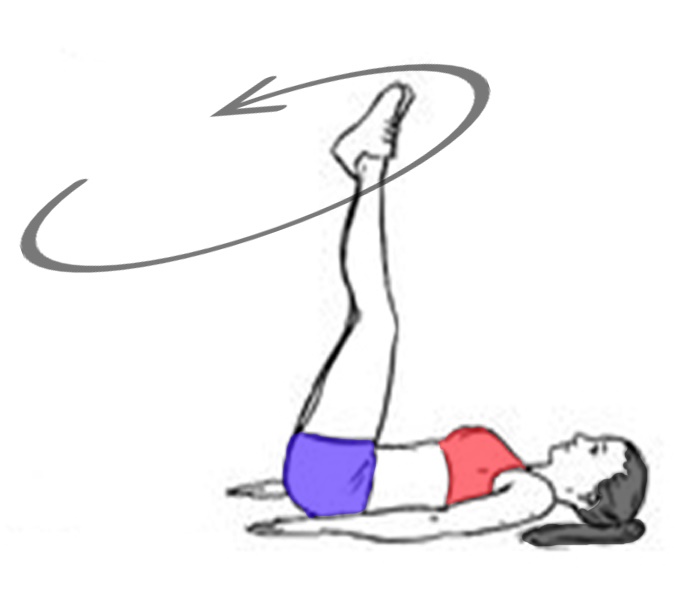
Padvritasana is used here for a supine leg-circle movement. One or both legs trace a controlled circle while the pelvis and trunk remain as steady as possible. The name and exact method are not standardised across every yoga school, so this guide clearly defines the variation being taught.
Navigator
What Padvritasana Means Here
The learning version begins with one leg at a time. Single-leg circles make it easier to notice whether the pelvis is rocking or the lower back is arching. Double-leg circles create more leverage and are an optional progression rather than a requirement.
Single-Leg Circle Steps
- Lie on the back with both knees bent and the feet on the floor.
- Keep the shoulders relaxed and the pelvis in a comfortable neutral position.
- Bring the right knee toward the torso and extend the leg only as far as comfortable. The knee may stay bent.
- Draw a small, slow circle from the hip while keeping the left foot grounded.
- Reduce the circle if the pelvis rocks or the lower back loses control.
- Complete three to five comfortable circles and then reverse direction.
- Place the right foot down and repeat with the left leg.
Double-Leg Circle Option
Double-leg circles require greater trunk control. Keep the knees bent, make the movement small and stop when the lower back arches or the pelvis swings. Many practitioners can continue using the single-leg version as their regular practice.
Lower-Back and Pelvic Control
- Make the circle smaller before trying to lower the leg closer to the floor.
- Keep the non-moving foot grounded during single-leg circles.
- Bend the moving knee to reduce leverage.
- Move slowly enough that you could stop at any point in the circle.
- Return to the starting position before reversing direction.
Breathing
Breathe continuously. You may inhale through part of the circle and exhale through the remainder, but there is no need to force the movement into a fixed breath ratio. Stop and reset if you notice breath holding.
Common Mistakes
- Making the circle larger than the pelvis can control.
- Using momentum.
- Locking the knee.
- Allowing the pelvis to roll strongly from side to side.
- Continuing after the lower back or groin becomes uncomfortable.
Possible Practice Benefits
Small controlled circles can develop hip-movement awareness, coordination and trunk control. The pose is better understood as a movement-quality exercise than as a targeted method for changing body shape or treating a condition.
Precautions and Modifications
- Use the single-leg, bent-knee version whenever the back feels easier that way.
- Stop for sharp pain in the lower back, hip, groin, abdomen or knee.
- After a recent injury or a period of restricted movement, use an individually appropriate movement plan.
- Stop for dizziness, numbness or unusual breathlessness.
How to Progress Leg Circles
Begin with a very small circle and use the pelvis as the main feedback point. If the pelvis stays quiet for several repetitions, increase the circle only slightly. You can also progress by slowing the movement instead of making it larger. Slow circles reveal whether momentum is doing the work and make it easier to pause at any point. This approach keeps the practice focused on coordination rather than range.
Single-Leg Versus Double-Leg Practice
Single-leg circles let the grounded leg provide stability and are usually easier to control. Double-leg circles remove that support and create greater leverage through the trunk. They are therefore not a necessary “advanced” goal. Choose the version that lets you keep the movement smooth, breathing continuous and the lower back comfortable. Quality is a more useful measure than the number of legs moving together.
Frequently Asked Questions
How large should the circles be?
Only as large as you can control without rocking the pelvis, arching the lower back or holding your breath.
Are double-leg circles better?
No. They are simply more demanding. Single-leg circles are often the better choice for control and learning.
Should the knee stay straight?
No. A bent knee reduces leverage and is a useful modification.