
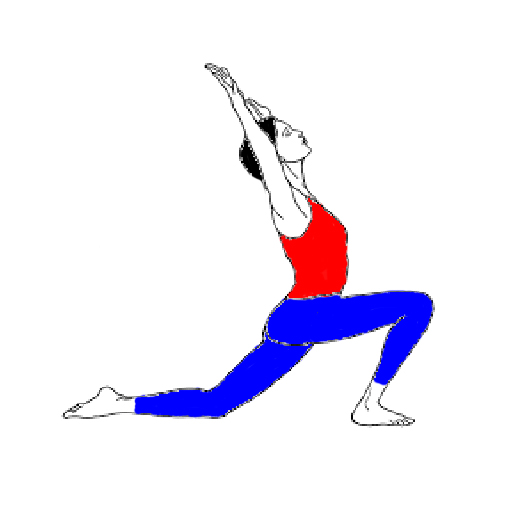
Ashwa Sanchalanasana, often called Equestrian Pose or Low Lunge, places one foot forward between the hands while the opposite knee rests on the mat. It appears in many Surya Namaskar sequences, but it can also be practised independently as a steady lunge.
The aim is not to force the pelvis toward the floor. A useful version keeps the front knee organised, the back leg comfortable and the breath smooth.
Navigator
Ashwa Sanchalanasana in Sun Salutation
In a traditional Sun Salutation, Ashwa Sanchalanasana usually follows a forward fold. One leg steps back as the chest lengthens forward. The exact sequence, gaze and breathing pattern vary across schools, so learn the complete round from a teacher rather than mixing instructions from different systems.
Step-by-Step Low Lunge Practice
- Begin on hands and knees or in a comfortable forward fold.
- Step the right foot between the hands. Help the foot forward with one hand if necessary.
- Lower the left knee and top of the foot to the mat.
- Place the hands on blocks if the floor feels too far away.
- Keep the right knee approximately above the ankle rather than pushing it far forward.
- Lengthen the breastbone forward while keeping the back of the neck long.
- Take two or three easy breaths without forcing the hips downward.
- Return to hands and knees or step forward with control, then repeat on the other side.
Knee and Hip Modifications
- Place a folded blanket beneath the back knee.
- Keep the hands on blocks to create more space for the torso.
- Shorten the stance if the front knee or back hip feels strained.
- Keep the back toes tucked when that feels more stable.
- Practise with both hands on the front thigh and the torso upright only when balance is steady.
- Use a chair beside the body for support when stepping is difficult.
Breathing and Alignment
- Inhale to lengthen the spine and broaden the chest.
- Exhale while softening unnecessary tension in the jaw and shoulders.
- Keep the front foot grounded through the heel and ball of the foot.
- Let the pelvis remain level rather than dropping heavily to one side.
- Draw the front knee in line with the middle toes.
- Avoid lifting the chin sharply or compressing the lower back.
Common Mistakes
- Placing the front foot too close to the hands and crowding the knee.
- Letting the front knee collapse inward.
- Forcing the hips downward to chase a deeper stretch.
- Pressing the back kneecap into a hard floor.
- Holding the breath while trying to balance.
- Throwing the head back instead of lengthening through the spine.
Possible Practice Benefits
A carefully supported lunge may build awareness of stepping, balance, hip extension, front-leg alignment and coordinated breathing. These are practice possibilities rather than guaranteed therapeutic effects.
Ashwa Sanchalanasana should not be described as a treatment for digestive, reproductive, spinal or circulation disorders.
Precautions and When to Modify
- Use extra padding or a standing alternative with current knee sensitivity.
- Shorten the stance with hip, groin or lower-back discomfort.
- Use a chair or blocks when balance is reduced.
- Pregnant practitioners may need a wider stance and individual modifications.
- Stop for sharp pain, numbness, dizziness or unusual shortness of breath.
Frequently Asked Questions
Must the back knee stay on the floor?
No. Some sequences use a lifted back knee, but the kneeling version is often easier for learning alignment.
Should the front knee move beyond the toes?
There is no single rule for every body, but keeping the knee approximately above the ankle is a practical starting point for a controlled low lunge.
Can blocks be used under the hands?
Yes. Blocks can reduce strain and help the spine lengthen without forcing the hips downward.
Related SarvYoga Guides
Safety Reference
The National Center for Complementary and Integrative Health advises practising yoga properly with qualified guidance and notes that some people may need individual instruction or modifications. See Yoga: Effectiveness and Safety.