
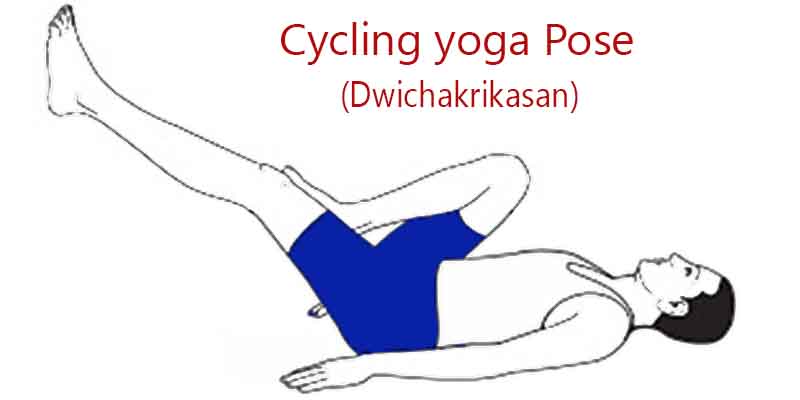
Dwichakrikasan is commonly taught as a lying cycling movement. The legs imitate pedalling while the trunk remains supported on the mat. It is a dynamic exercise rather than a static posture, and the range should be small enough to keep the lower back comfortable.
Navigator
What Dwichakrikasan Means Here
This guide uses slow, controlled leg movements with normal breathing. It does not require the feet to travel close to the floor, and it should not be used as a test of abdominal strength.
Single-Leg Cycling Steps
- Lie on the back with both knees bent and feet on the floor.
- Relax the shoulders and keep the neck neutral.
- Bring the right knee toward the torso.
- Extend the right leg forward and upward through a comfortable range, then bend the knee back toward the torso.
- Continue slowly for three to six circles while the left foot remains grounded.
- Reverse the direction with the same control.
- Return the right foot to the floor and repeat with the left leg.
Two-Leg Cycling Option
Lift both knees and make a small cycling action only when the single-leg version is comfortable and the lower back remains controlled. Keep the knees bent and the movement high rather than reaching the feet close to the floor. Return one foot at a time when finishing.
Lower-Back-Friendly Modifications
- Use one leg at a time.
- Keep the moving knee more deeply bent.
- Make a smaller circle.
- Rest the non-moving foot on the floor.
- Place the hands on the front of the pelvis to notice rocking rather than pressing beneath the back.
Breathing and Pace
Breathe continuously at a pace that allows easy control. There is no required breathing ratio. Slow down or stop if the movement causes breath-holding, abdominal gripping or a large back arch.
Common Mistakes
- Pedalling quickly with momentum.
- Lowering the legs farther than the trunk can control.
- Pulling the head and shoulders off the mat.
- Holding the breath.
- Continuing through lower-back, hip or groin pain.
Possible Practice Benefits
Controlled cycling movements may develop coordination, hip movement awareness and trunk control. They can also provide light dynamic movement in a short yoga sequence. These are general practice possibilities, not guaranteed outcomes.
Use Dwichakrikasan as a coordination and movement exercise rather than as a targeted body-composition or health practice.
Precautions and When to Stop
- Stop when the lower back arches strongly or becomes painful.
- Use individual guidance after recent abdominal, spinal, hip or pelvic injury or surgery.
- People with hernia, pregnancy or health conditions affected by abdominal effort should ask for an appropriate alternative.
- Stop for dizziness, nausea, numbness, groin pain or unusual shortness of breath.
Frequently Asked Questions
Should I cycle close to the floor?
No. Keep the legs high enough to maintain comfortable control of the pelvis and lower back.
Is the two-leg version better?
No. It is simply more demanding. The single-leg version is the better choice for many practitioners.
How many repetitions should I do?
Begin with only a few slow circles in each direction and stop before form or breathing changes.
Related SarvYoga Guides
Safety Reference
The National Center for Complementary and Integrative Health advises practising yoga properly with qualified guidance. It also notes that children, pregnant people, older adults and people with health conditions may need individual instruction or modifications. See Yoga: Effectiveness and Safety.