
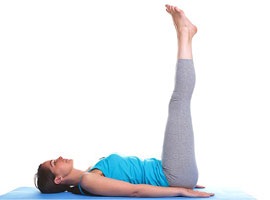
Ardha Halasana, or Half Plough Pose, is taught here as a supine leg-lift posture. The back of the head, shoulders, trunk and pelvis stay on the mat while the legs rise through a manageable range. The legs do not travel overhead as they do in full Halasana.
Navigator
What the Name Means
Ardha means half, hala means plough and asana means posture. The name can refer to different partial forms in different teaching traditions. In this SarvYoga guide it means a controlled leg lift from a lying position.
Set Up the Pose
- Use a firm, comfortable mat.
- Lie on the back with the knees bent and feet on the floor.
- Place the arms beside the body with the palms down or facing inward.
- Keep the back of the head centred and the front of the throat relaxed.
- Take a few natural breaths before moving the legs.
Ardha Halasana Steps
- Exhale and bring one knee toward the torso.
- Bring the second knee up while keeping the pelvis steady.
- Pause with both knees bent and notice the contact of the back with the mat.
- Begin to extend the legs upward. Keep a slight bend in the knees if needed.
- Stop at the angle where the legs can be held without a strong lower-back arch.
- Continue ordinary breathing and keep the shoulders, jaw and hands relaxed.
- Hold briefly with control rather than aiming for a long duration.
- Bend the knees toward the torso.
- Place one foot and then the other on the floor.
- Rest before repeating.
Breathing and Alignment
Exhale as the knees move toward the torso and continue with natural breathing as the legs rise. Do not hold the breath to create extra effort. The pelvis may respond slightly to the movement, but avoid pressing the lower back aggressively into the floor.
- Use a smaller leg angle when the lower back lifts strongly.
- Keep the legs active without locking the knees.
- Let the ribs remain quiet rather than flaring upward.
- Keep the head and neck still throughout the movement.
- Lower the legs by bending the knees instead of dropping straight legs.
Bent-Knee Modification
Keep the knees bent at roughly a right angle and hold the thighs above the pelvis. This shortens the lever created by the legs and makes it easier to explore trunk control. The knees do not need to straighten for the posture to be useful.
One-Leg Variation
Keep one foot on the floor while lifting the other leg. Change sides after a short pause. This variation helps the practitioner observe whether one side moves differently and reduces the effort of lifting both legs together.
Wall-Supported Option
Rest the legs against a wall instead of holding them in the air. Adjust the distance from the wall until the back and hips feel settled. This is a supported alternative, not a test of whether the legs can become perfectly vertical.
Common Mistakes
- Swinging the legs upward with momentum.
- Insisting that the legs reach a right angle.
- Holding the breath during the lift.
- Hardening the jaw, throat or shoulders.
- Pressing the head into the mat.
- Lowering both straight legs after control has been lost.
How to Include It in Practice
Begin with one or two controlled repetitions. Ardha Halasana can follow a gentle supine warm-up and may be paired with a restful bent-knee position afterward. Quality matters more than repetition count.
If the full leg lift is not steady, stay with the bent-knee or one-leg version. A qualified yoga teacher can help choose the variation that matches the practitioner’s current control.
Practice Limits
Stop if the movement causes sharp discomfort, pressure in the neck, tingling, dizziness or loss of comfortable breathing. Do not force the legs higher or continue once the back begins to lift without control. Full Halasana and stronger abdominal variations should be learned separately.
Frequently Asked Questions
Must the legs reach 90 degrees?
No. Raise the legs only to the angle that allows steady breathing and controlled alignment.
Can the knees remain bent?
Yes. Bent knees are a useful variation and often make the movement easier to control.
Is Ardha Halasana the same as full Halasana?
No. In this version the legs stay above the pelvis and do not move overhead toward the floor.
How long should I hold the pose?
Start with a brief, comfortable pause. End the hold before the back arches strongly or the breath becomes restricted.
can we eat right after any yogashan…
@Nihariika, it’s a good question and thanks for asking. You have to take 3 to 5 hours gap between your meal & practice. As you end your Yoga session wait for 15 to 20 minutes then you’ll take your meal.
May God bless you.
Regards.
If I have a glass of milk how long should I wait to do ardha halasana or any asana