
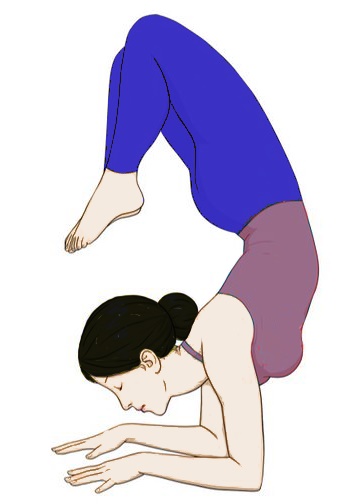
Vrschikasana, or Scorpion Pose, is an advanced inversion combining a forearm balance with a deep backbend and knee flexion. It requires substantial shoulder stability, upper-back mobility, balance and the ability to exit safely.
This page is not an invitation to kick into the full posture alone. The full pose should be learned in person with an experienced teacher, appropriate spotting and a clear assessment of readiness. Many practitioners should remain with preparatory poses.
Navigator
Why Vrschikasana Requires Direct Supervision
- The body is inverted while the spine moves into extension.
- The shoulders and forearms support most of the body weight.
- A loss of balance can load the neck, head, shoulders or lower back.
- Visual orientation and balance change as the feet move toward the head.
- A teacher must be able to assess alignment, fatigue and a safe exit.
Prerequisite Skills Before Scorpion Pose
These skills do not guarantee readiness, but their absence is a reason not to attempt the full posture:
- A stable Dolphin Pose with the shoulders organised over the forearms.
- A controlled Forearm Plank without collapsing through the upper back.
- Comfortable, non-weight-bearing backbend preparation.
- A teacher-supervised forearm balance with a reliable exit.
- The ability to maintain smooth breathing while inverted.
- No current neck, shoulder, wrist, elbow or back pain.
Teacher-Led Preparation Sequence
- Warm the shoulders and thoracic spine with non-inverted movements.
- Practise Dolphin Pose and Forearm Plank to organise the shoulder girdle.
- Use Sphinx Pose or a low cobra for controlled spinal extension.
- Practise forearm-balance alignment at a wall only under direct instruction.
- Learn how to come down before exploring any backbend component.
- Add only a small knee bend while the shoulders remain stable.
- Stop immediately when balance, breathing or shoulder position deteriorates.
The full shape, including moving the feet toward the head, is optional and is not required for meaningful yoga practice.
Wall Use and Spotting
- A wall does not remove the need for supervision.
- Do not kick repeatedly into the wall.
- Place the forearms so they do not slide apart.
- Use appropriate padding without creating an unstable surface.
- A teacher or trained spotter should control the direction of the legs and assist the exit.
- Do not allow the head to bear weight as a substitute for shoulder stability.
Safer Alternatives
- Dolphin Pose with the feet on the floor.
- Forearm Plank with the knees down or legs extended.
- Sphinx Pose for a low, controlled backbend.
- Pincha Mayurasana preparation without adding a backbend.
- Wall-supported shoulder-flexion drills performed upright.
- Supported Bridge Pose when a prone or inverted backbend is unsuitable.
Common Mistakes
- Kicking up without a teacher or reliable exit strategy.
- Letting the elbows widen and shoulders collapse.
- Compressing the lower back before establishing upper-back extension.
- Dropping the head or bearing weight through the skull.
- Holding the breath while inverted.
- Continuing after fatigue changes the shoulder position.
Possible Practice Effects
Preparatory work may develop shoulder awareness, forearm weight-bearing, balance and controlled spinal extension. The full pose is not necessary to obtain these practice experiences, and no medical benefit is guaranteed.
Contraindications and Safety Limits
- Do not attempt the full pose with current neck, shoulder, elbow, wrist, back or head injury.
- Avoid unsupported inversions with uncontrolled blood-pressure concerns, significant cardiovascular conditions, glaucoma or conditions for which inversion is medically restricted.
- Pregnant practitioners should not begin or intensify this advanced inversion.
- People with dizziness, fainting, balance disorders or reduced bone strength need individual professional guidance.
- Stop for pain, numbness, tingling, visual disturbance, headache, nausea or unusual breathlessness.
Frequently Asked Questions
Can beginners practise Vrschikasana?
No. Beginners should work on foundational shoulder, forearm and backbend skills without attempting the full inversion.
Is a wall enough for safety?
No. A wall can assist some drills, but it cannot assess readiness, prevent every fall or replace an experienced teacher and spotter.
Should the feet touch the head?
No. That visual endpoint is optional and may encourage unsafe compression. Stable shoulders, controlled breathing and a safe exit are more important.
Related SarvYoga Guides
Practice Summary
Use a comfortable range, stop for sharp pain, numbness, tingling, dizziness or unusual breathlessness, and seek qualified instruction when a posture is advanced or symptoms persist.