
Sucirandhrasana, commonly called Eye of the Needle Pose or Reclined Figure Four, is a supine hip-opening asana. The name combines suci, meaning needle, with randhra, meaning opening. The crossed-leg shape resembles thread passing through the eye of a needle.
The pose is usually practised on the back, where the floor supports the spine. The lower foot may remain on the floor, press against a wall or lift toward the chest. Each option can teach the hip action without pulling the legs into a fixed range.
Navigator
Prepare the Supine Base
Lie on the back with both knees bent and the feet on the mat. Place the feet approximately hip-width apart. Let the back of the pelvis feel evenly grounded and keep the head centred.
- Use a folded blanket under the head when the chin lifts.
- Keep a strap nearby for the back of the thigh.
- Check that the feet are far enough from the pelvis for the knees to feel easy.
- Practise lifting one foot at a time without changing the position of the spine.
- Move the ankles gently before crossing the legs.
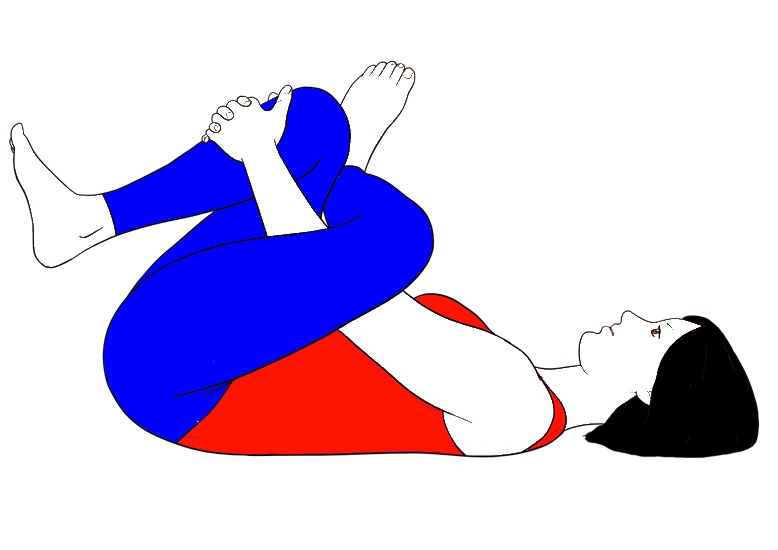
Sucirandhrasana Steps
- Begin with both feet grounded and the knees pointing upward.
- Lift the right foot and cross the right ankle over the left thigh.
- Flex the right ankle gently so the foot remains active.
- Keep the right knee moving away from the chest without pressing it with the hand.
- Stay here, or lift the left foot and bring the left thigh toward the torso.
- Thread the right hand through the space between the legs.
- Join the hands behind the left thigh, or hold a strap around the thigh.
- Keep the head, shoulders and pelvis resting on the floor.
- Take several smooth breaths and observe the outer right hip.
- Release the hands, return both feet to the mat and repeat on the other side.
Wall and Strap Modifications
For a wall version, lie with the feet on a wall and the knees bent near a right angle. Cross one ankle over the opposite thigh and adjust the distance from the wall. Moving farther away reduces the intensity.
When the hands cannot reach behind the thigh without lifting the shoulders, loop a strap around the back of the thigh. Hold one end in each hand and keep the elbows relaxed. Avoid holding directly over the knee.
Seated Figure-Four Option
Sit toward the front of a firm chair with both feet grounded. Cross the right ankle over the left thigh and keep the ankle active. Remain upright or hinge slightly forward from the hips. The seated version is easy to adjust and does not require lying down.
Keep the crossed foot beyond the opposite thigh rather than placing it directly on the knee. Support the lifted knee with a block or folded blanket when it hangs without ease.
Alignment Cues
- Keep the crossed ankle gently flexed.
- Let the crossed knee move through available hip range without hand pressure.
- Maintain a neutral, comfortable pelvis.
- Keep the shoulders and head supported.
- Hold behind the thigh rather than over the knee.
- Use the same setup time and attention on both sides.
Common Mistakes
- Pressing the crossed knee away with the hand.
- Letting the crossed foot become loose or sickled.
- Pulling the lower leg so strongly that the pelvis curls up.
- Lifting the head and shoulders to reach the thigh.
- Holding the breath during the strongest part of the stretch.
- Comparing the two sides and forcing them to look identical.
Practice Effects
Sucirandhrasana develops awareness of outward hip rotation while the spine remains supported. The pose also teaches how wall distance, hand position and strap length can change intensity. These choices make it useful in both individual practice and teacher-led sequences.
Practice Limits
Release the pose if there is sharp discomfort, tingling, numbness or pressure in the knee, hip or lower back. Keep the lower foot grounded or use the chair version whenever lifting the leg disturbs the spine. The crossed knee should move only through available range.
Frequently Asked Questions
Must I pull the lower thigh toward the chest?
No. Keeping the foot on the floor is a complete beginning variation.
Where should I hold?
Hold behind the thigh or use a strap. Avoid pulling directly on the knee.
Can I practise on a chair?
Yes. The seated figure-four version offers the same crossed-leg organisation with an upright torso.