
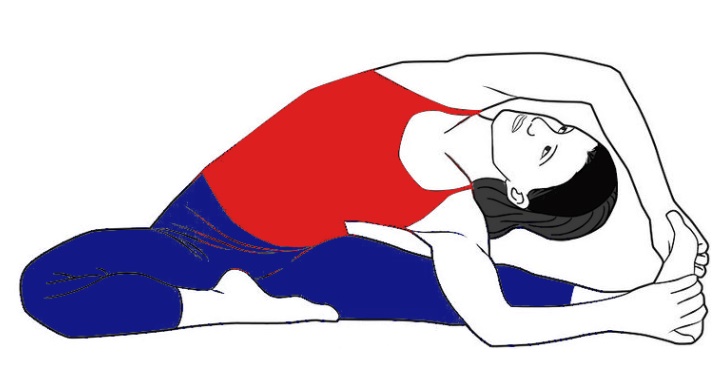
Parivrtta Janu Sirsasana is commonly called Revolved Head-to-Knee Pose. It combines an asymmetrical seated position with a side bend and gentle rotation toward the extended leg.
The name can be misleading: the head does not need to touch the knee. The priority is a long side body, steady breathing and a pain-free position for the bent knee, hip and lower back.
Navigator
Prepare the Hips and Side Body
- Sit on a folded blanket if the pelvis rolls backward.
- Practise Titli Asana or a comfortable cross-legged seat first.
- Use a strap around the extended foot before reaching for it.
- Keep the bent knee supported on a block or folded blanket.
- Practise a simple seated side bend before adding rotation.
Step-by-Step Revolved Head-to-Knee Practice
- Sit with the right leg extended and bend the left knee comfortably out to the side.
- Place the left foot near the inner right thigh without pressing the knee down.
- Turn the torso slightly toward the bent-knee side.
- Place the right forearm or hand inside the right leg, on a block or on the floor.
- Inhale and lift the left arm overhead.
- Exhale and lengthen the left side of the body toward the right foot.
- Keep the chest open enough to breathe; do not force the upper shoulder backward.
- Hold for two or three comfortable breaths.
- Inhale to return upright, release the legs and repeat on the other side.
Strap and Chair Modifications
- Loop a strap around the extended foot and hold it with the lower hand.
- Place the lower forearm on a block rather than reaching the floor.
- Support the bent knee with a folded blanket.
- Keep the top hand on the hip instead of reaching overhead.
- Sit sideways on a chair and practise a small side bend with one leg extended.
- Keep the gaze forward when turning the neck is uncomfortable.
Breathing Without Forcing the Twist
- Inhale to create length through both sides of the waist.
- Exhale into a small side bend without collapsing the lower ribs.
- Allow rotation to come from the upper back rather than cranking the neck.
- Keep the extended leg active without locking the knee.
- Reduce the range if the breath becomes shallow.
- Return upright on an inhalation with controlled abdominal support.
Common Mistakes
- Pulling hard on the foot to create a deeper shape.
- Pressing the bent knee toward the floor.
- Rounding the spine and collapsing toward the extended leg.
- Turning the face upward when the neck feels compressed.
- Letting the extended leg roll strongly inward or outward.
- Holding the breath during the side bend.
Possible Practice Benefits
With suitable support, this pose may develop awareness of seated side bending, upper-back rotation, hamstring length, hip positioning and breath in the side ribs. These are practice possibilities, not guaranteed health outcomes.
Parivrtta Janu Sirsasana should not be promoted as a treatment for digestive, spinal, reproductive or respiratory conditions.
Precautions and When to Avoid
- Modify or avoid with current knee, hip, hamstring, rib, shoulder or lower-back pain.
- Keep the gaze neutral with neck pain, headache or dizziness.
- Avoid forcing the pose after recent abdominal, spinal or joint surgery.
- Pregnant practitioners need a spacious, non-compressive variation.
- Stop for sharp pain, tingling, numbness or restricted breathing.
Frequently Asked Questions
Must the head touch the knee?
No. The pose can be complete as a supported side bend with the head well above the leg.
Should the top shoulder roll fully backward?
Only within comfort. Keep enough openness to breathe without forcing the ribs or shoulder.
Can the bent knee be supported?
Yes. A blanket or block under the thigh can reduce strain at the knee and hip.
Related SarvYoga Guides
Safety Reference
The National Center for Complementary and Integrative Health advises practising yoga properly with qualified guidance and notes that some people may need individual instruction or modifications. See Yoga: Effectiveness and Safety.