
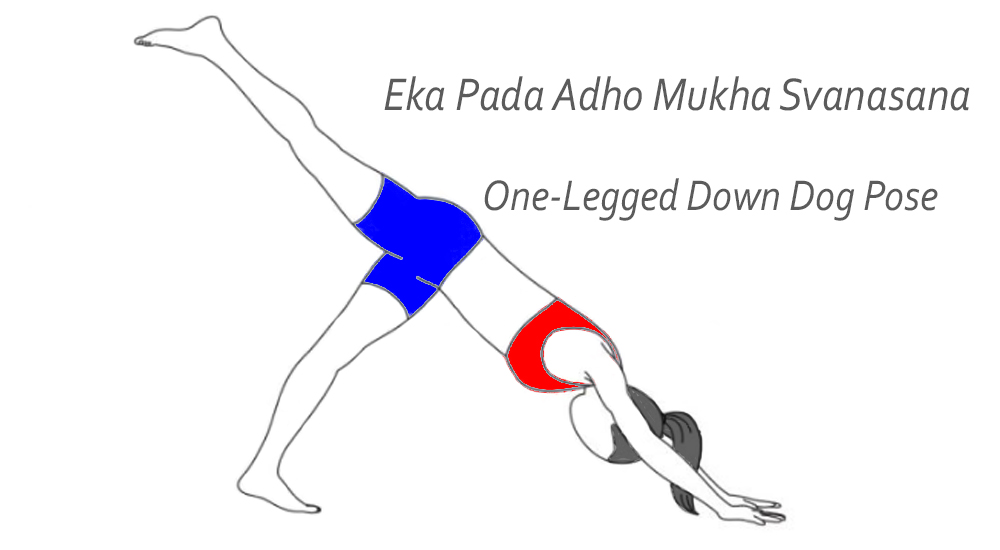
Eka Pada Adho Mukha Svanasana is commonly called One-Legged Downward-Facing Dog or Three-Legged Dog. It begins in Adho Mukha Svanasana and lifts one leg while the hands, shoulders and standing leg continue to support the body.
The lifted leg does not need to rise high. A smaller lift with steady shoulders and controlled pelvic alignment is usually more useful than chasing height.
Navigator
Build a Stable Downward-Facing Dog
- Begin on hands and knees with the hands slightly ahead of the shoulders.
- Spread the fingers and press through the knuckles and palms.
- Tuck the toes and lift the knees.
- Keep the knees bent while lengthening the spine.
- Move the chest gently toward the thighs without collapsing into the shoulders.
- Settle into a version that allows normal breathing before lifting a leg.
Step-by-Step One-Legged Down Dog
- From a stable Downward-Facing Dog, shift slightly more weight into both hands.
- Keep the left foot grounded and bend the left knee if necessary.
- Inhale and extend the right leg backward and upward to a comfortable height.
- Keep both hip points facing approximately toward the floor for the neutral version.
- Press evenly through both hands and keep the shoulders away from the ears.
- Take one or two smooth breaths.
- Exhale and return the right foot to the floor with control.
- Pause in ordinary Downward-Facing Dog or Child’s Pose, then repeat on the other side.
Wall and Bent-Knee Modifications
- Keep the standing knee bent to reduce hamstring and calf tension.
- Lift the leg only a few centimetres while keeping the pelvis steady.
- Practise with the hands on a wall and one leg extending backward.
- Use blocks under the hands when wrist extension and shoulder range allow.
- Lower to hands and knees and extend one leg straight behind instead.
- Rest in Child’s Pose between sides when the arms tire.
Keep the Pelvis Organised
- For the neutral version, point the toes of the lifted leg toward the floor.
- Avoid rolling the lifted-side shoulder backward with the hip.
- Keep the ribs from flaring as the leg rises.
- Press the floor away evenly through both arms.
- Lengthen the lifted heel backward before raising it higher.
- Choose control over range.
Common Mistakes
- Lifting the leg so high that the lower back compresses.
- Twisting the pelvis unintentionally.
- Collapsing more weight into one wrist.
- Locking the standing knee while the spine rounds.
- Holding the breath during the lift.
- Dropping the lifted foot heavily when exiting.
Possible Practice Benefits
A controlled one-legged Down Dog may build awareness of weight distribution, shoulder stability, hip extension, balance and coordinated breathing. These are practice possibilities and not guaranteed medical benefits.
The pose should not be presented as a treatment for circulation, digestive, hormonal, neurological or spinal conditions.
Precautions and When to Modify
- Use a wall or hands-and-knees version with current wrist, shoulder or balance limitations.
- Avoid the pose with acute back, hamstring, calf or ankle pain.
- People with dizziness or pressure-sensitive conditions should seek individual guidance before prolonged inverted positions.
- Pregnant practitioners may need a wall-supported alternative and personalised instruction.
- Stop for sharp pain, numbness, tingling, dizziness or visual disturbance.
Frequently Asked Questions
How high should the lifted leg go?
Only as high as you can maintain steady shoulders, smooth breathing and comfortable control through the pelvis and lower back.
Can the standing knee stay bent?
Yes. A bent standing knee can make it easier to lengthen the spine and keep the movement controlled.
Should the lifted hip open?
Some sequences teach an open-hip variation, but first learn the neutral version with both hip points facing the floor.
Related SarvYoga Guides
Safety Reference
The National Center for Complementary and Integrative Health advises practising yoga properly with qualified guidance and notes that some people may need individual instruction or modifications. See Yoga: Effectiveness and Safety.