
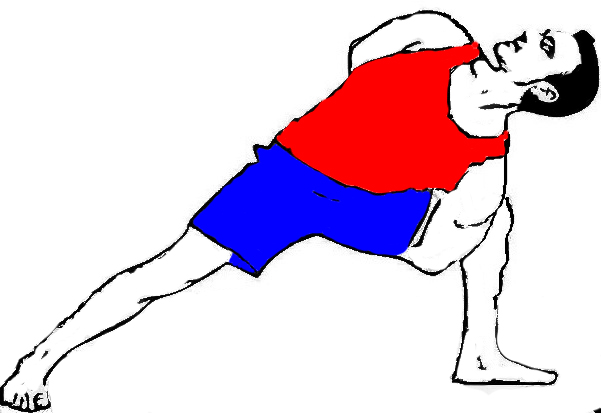
Bound Revolved Half Moon Pose, often called Baddha Parivrtta Ardha Chandrasana, combines a one-leg balance, a standing twist and an arm bind around the standing leg. Hand placement and naming can differ between yoga traditions.
This is an advanced standing balance. It should be learned directly from a qualified yoga teacher. Written instructions cannot assess fall risk, joint range, balance, breathing or whether the bind is suitable for an individual practitioner.
Navigator
Skills Needed Before the Full Pose
- Stable Half Moon and Revolved Half Moon with a block.
- Controlled standing balance without gripping the toes.
- Comfortable rotation through the upper back without forcing the lower back.
- Shoulder movement for a bind without pulling or twisting the arms.
- The ability to leave the pose slowly without falling or hopping.
Teacher-Led Progression
- Practise near a wall in a clear, non-slip area with a teacher supervising.
- Begin from a supported standing position and place the lower hand on a block rather than the floor.
- Shift weight into the standing leg and extend the other leg back only as far as balance remains steady.
- Organise the pelvis and spine before adding rotation. Keep the standing knee soft rather than locked.
- Rotate gradually toward the standing leg without forcing the lower back or neck.
- Remain in the unbound version until the breath, balance and standing leg are stable.
- A full arm bind around the standing leg should be introduced only by a teacher who can see the exact shoulder and spinal position.
- Exit the bind first, return both hands to support, lower the lifted foot and stand upright slowly.
Unbound Modification
The unbound version is the preferred modification for most practitioners. Keep one or both hands on blocks, use a wall for balance and reduce the twist. There is no need to bind in order to practise balance and rotational awareness.
Alignment and Breathing
- Keep the standing foot rooted and the knee tracking in the same general direction as the toes.
- Use the block to create space rather than collapsing toward the floor.
- Rotate through the upper back while keeping the abdomen and breath comfortable.
- Keep the gaze down or sideways when looking upward affects balance or the neck.
- Breathe normally and leave the pose before the standing leg begins to shake strongly.
Common Mistakes
- Attempting the bind before the unbound balance is stable.
- Locking or twisting the standing knee.
- Forcing the shoulders behind the leg.
- Using momentum, hopping or falling into the wall.
- Holding the breath to maintain the pose.
- Turning the head farther than the upper back can rotate comfortably.
Possible Practice Benefits
With qualified instruction, the pose may challenge balance, coordination, standing-leg strength, trunk control and shoulder awareness. It is not necessary for general yoga practice, and the unbound variation can provide a meaningful balance challenge.
Use the pose to explore balance, rotation and shoulder awareness rather than to promise outcomes beyond yoga practice.
Precautions and When to Avoid
- Avoid unsupervised attempts, especially when the unbound version is not stable.
- Use another pose when you have current ankle, knee, hip, back, neck, wrist or shoulder pain.
- Choose a simpler variation when a recent change in movement, balance or comfort makes the advanced version unsuitable.
- During pregnancy, use pregnancy-specific yoga guidance and avoid adding a deep closed twist or fall-risk balance.
- Stop immediately if the pose causes sharp discomfort, numbness, visual disturbance, dizziness or an inability to exit steadily.
Frequently Asked Questions
Is the bind required?
No. The unbound version with blocks is a complete practice option and is more appropriate for many people.
Can a wall make the pose safe for beginners?
A wall can provide orientation, but it does not make an advanced twist and bind suitable for a beginner or replace direct instruction.
Where should I look?
Use a gaze direction that keeps the neck comfortable and the balance steady. Looking down is valid.
Related SarvYoga Guides
Practice Guidance
Practise with direct yoga-teacher guidance, use blocks or a wall when needed, and leave the pose before balance or breathing becomes strained. See Yoga for Beginners.