
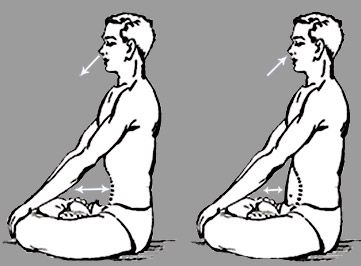
Kapalbhati is a traditional yogic practice characterised by short, active exhalations followed by passive inhalations. The name is commonly explained through the Sanskrit words kapala, meaning skull or forehead, and bhati, meaning shining or illuminating.
Kapalbhati is often discussed beside pranayama, although traditional teaching systems may also classify it among cleansing practices. The important learning point is the breathing pattern: the exhalation is deliberate, while the inhalation is allowed to return without being pulled in.

Navigator
Preparation
- Sit on a folded blanket or chair with the spine comfortably upright.
- Rest the hands on the thighs and soften the shoulders, jaw and face.
- Observe natural breathing for several rounds.
- Practise when the stomach feels comfortably light.
- Begin only after you can distinguish active exhalation from passive inhalation.
Padmasana is not required. Any steady seat that permits easy breathing can be used.

Understanding the Breath Pattern
During an active exhalation, the lower abdomen moves inward briefly and air leaves through the nostrils. The abdomen then releases and the inhalation returns by itself. The shoulders and chest do not need to pump with every breath.
Practise one isolated exhalation, pause, and observe the natural inhalation. Repeat that slowly before joining several repetitions into a round. A clear slow rhythm is the foundation for any later increase in pace.
Kapalbhati Steps
- Sit steadily and let the breath settle.
- Inhale naturally without trying to take an unusually large breath.
- Make one short exhalation by drawing the lower abdomen inward.
- Release the abdomen immediately and allow the inhalation to return.
- Repeat at a slow, even pace for a small number of cycles.
- Stop the active rhythm and return to ordinary breathing.
- Rest quietly for at least several breaths.
- Begin another short round only if posture, rhythm and attention remain clear.
Beginner Pacing
A beginner may start with five to ten distinct exhalations followed by a generous rest. The exact count is less important than coordination. If the inhalation becomes noisy, the face tightens or the torso starts rocking, reduce the speed and number.
Do not use a fast pace merely because Kapalbhati is sometimes demonstrated quickly. The breathing pattern should remain recognisable at every repetition.
Posture and Hand Options
- Sit cross-legged on enough height for the pelvis to feel level.
- Use Vajrasana only when kneeling is already comfortable.
- Choose a chair when the floor seat causes the spine to round.
- Rest the palms down for a grounded position or upward for a lighter hand position.
- Keep the elbows easy and avoid pressing the hands into the knees.
Common Mistakes
- Actively pulling air in after each exhalation.
- Moving the shoulders, chest or head with every repetition.
- Using excessive abdominal force.
- Increasing speed before the pattern is coordinated.
- Continuing after the rhythm becomes uneven.
- Adding breath retention, bandha or a fixed ratio without instruction.
- Skipping the quiet rest between rounds.
After the Practice
Stop the active exhalations and let the breath choose its own pace. Observe the movement at the nostrils, ribs and abdomen without correcting it. A quiet pause helps distinguish the active technique from ordinary breathing.
If another gentle practice follows, begin only after the breath feels settled. Do not move directly from a forceful round into an unfamiliar technique.
Kapalbhati and Other Pranayama Practices
The SarvYoga pranayama learning hub groups techniques by their main pattern. Kapalbhati and Bhastrika both involve active breathing, but their mechanics are not identical. Alternate-nostril practices such as Anulom Vilom and Nadi Shodhana use a different rhythm and hand organisation.
Practice Limits
Stop immediately if there is dizziness, sharp discomfort, pressure, agitation or loss of coordination. Return to ordinary breathing and do not restart that session. Fast rounds, long rounds, retention, ratios, bandha and combinations with other strong techniques require direct guidance from a qualified yoga teacher.
Frequently Asked Questions
Is the inhalation active?
No. In basic Kapalbhati, the exhalation is active and the inhalation returns passively.
How fast should a beginner practise?
Slowly enough to feel every exhalation and every release. Clarity comes before speed.
Is breath retention part of the basic round?
No. Begin without retention and add advanced elements only in supervised study.
Explore SarvYoga Pranayama Guides
- Traditional context of pranayama
- Pranayama breathing-practice hub
- Bhastrika Pranayama
- Bahya Pranayama
- Anulom Vilom Pranayama
- Nadi Shodhana Pranayama
- Ujjayi Pranayama
- Bhramari Pranayama
- Udgeeth Pranayama
- Pranav Pranayama
- Sheetkari Pranayama
- Sheetali Pranayama
- Chandra Bhedana Pranayama
- Surya Bhedana Pranayama
- SarvYoga yoga-pose library
- Seated and standing yoga-pose sequence
The content read through this website and if practiced regularly and as i intend to do so will change my entire life ( My mind, body and soul) . thanks , wish to get connected to you, please advice and guide. – Keyur Doshi
thnx@Keyur Doshi for your experience sharing with us.
i have frozen shoulder can capalbhati help this to release. i also want to loose weight can this help?
For frozen shoulder follow These asanas which are given below:
1. Adho Mukha svanasana
2. shoulder rotation.
3. Tadasana.
4. Cat Pose
6. Gomukhasana.
for weight loss, Kapalbhati is the best breathing technique. along with kapalbhati. Daily drink a full glass of lemon juice with lukewarm water add one teaspoonful honey. Take this solution regularly when you wake up from your bed.
Thanks for sharing your views.
OM.
Hi. Pls tell me that we have to inhale once at starting or we can inhale in between also?
It is continuously exhale process or exhale inhale , exhale inhale process?
It’s a exhale and inhale process, but in exhale process we have to make some force during exhale, by this your stomach goes little backward and you fell this.Thnx
Within how many months wil i loose weight if i try kapalbhati on empty stomach for 10mins in the morning?
@su, benefits take time, first increase the time day by day (20 to 25 minutes). Along with kapalbhati take Aloe Vera juice with empty stomach for weight loose. Keep practising.
Hi
People having acidity or gastric problem should not do this pranayam?
kapalbhati Pranayam is best for gastric and acidity problems. So you should do this.
I have a heart murmur problem can I do kapalbhati pranayaam please guide. Thank you
If you have high BP then you should avoid the practice.. if not then you can practice but at a slower rate.. apart from Anulom- vilom ( alternate nostril breathing) pranayam will be very helpful for u.. practice it daily for 30. Min. Or for 60. Min…. Stay blessed tc
i have a blocked fallopian tubes at right side and the left one is open.
can kapalbhati is usefull for this ? if yes, how long should i do kapalbhati daily?
@deepti, In Asana, do Matsyasana, Dhanurasana, Uttithapadasana, Bhujangasana, Padahastasana, Gomukhasana, Paschimottasana. Yes Kapalbhati is useful in this and Anulom – vilom also.
If these tubes get blocked it gets difficult to conceive and have a baby. The fallopian tubes might get blocked due to several reasons such as disease that cause an inflammation of the pelvic region, gonorrhea, miscarriage, contraceptive methods and pregnancy termination. You need to concern a gynecologist before you start any yoga Asana or exercise.
@Deepti, In Asana do Matsyasana, Dhanurasana, Uttithapadasana, Bhujangasana, Padahastasana, Gomukhasana, Paschimottasana. Yes Kapalbhati is beneficial in this and Anulom – Vilom Pranayama also.
If these tubes get blocked it gets difficult to conceive and have a baby. The fallopian tubes might get blocked due to several reasons such as disease that cause an inflammation of the pelvic region, gonorrhea, miscarriage, contraceptive methods and pregnancy termination. You need to Concern a gynecologist before you start any yogic activities or other form of exercise,
How to perform bhugatana kapal bhati.please Provide detail method citing finer points.how to bring out water in the mouth from nostrils?
@Hari for doing jal neti (bring out the water from nostrils) you have to clear the basic asana and pranayama, and this is comes under the shatkarma. for doing this you need one trainner. coz jal neti needs trainner’s attention and supervision. Very Soon we provide an article regarding Bhugatana Kapal Bhati. so connected with us. And See our Shatkrama section for jal neti.
Dear sir,
I’m having acidity heavily from 2013. In 2014 endoscopy report was normal. In 2015 report says grade a oesphagatis. In 2016 reports says hital hernia but in 2017 report says normal. All medicines are reducing acidity but at the same i’m getting heat boils , body gets heating and acidity increasing again. I could not understand what to do . I started kapalbhatia pranayam acidity reducing but again same problem heat increasing.. please help i could not do shetali pranayam as i cannot roll the tongue. And i dont understand why kapalbhatia pranayam increasing temperature in body as it is natural. My age 26. Please helpp will waiting for your reply.
Thanks in advance
@krihna Chaitanya,First of all thnx for sharing your point. Kapalbhati pranayam produce the heat in the body but not too much. If your not able to do Shetali then try sheetkari for cooling down your body. As you Said, that you couldn’t roll your tongue while doing shetali, for this roll your tongue as much as you can. Along with do Anulom vilom. Take balance food, avoid fast food, oily food and spicy meal. For acidity Follow these asana: Paschimottanasana, Supta Badhakonasana,Marjaryasana,Ardha Matsyendrasana. After taking meal do Vajrasana daily. If your stomach is clear then, these disease are kicked away. Constipation is the common problem for most of stomach related problems. Allopathic medicines is not the permanent solution for your problem. Please believe consult an ayurvedic doctor and do above mention asana and pranayama daily. May god bless you. Keep in touch with us.
Dear sir,
Thank you for suggesting i cured my acidity with anulom vilom pranayam and sheetakariii hats offffff to yoga. I dumped all medicines in dustbin all because of pranayam. Now i got another problem due to smartphones and laptops my eyes are drying getting tears from my eyes can u help me please……
@Krishna, It’s sound good that you cured your acidity by practicing yogic activities. It’s all your hard work and practice. For your newly born problem, first of all don’t be slaved of gadgets. Before washing your face, take some water in your mouth but don’t drink it and splash your eyes with water 2 – 5 times after that spit your mouth water. Tratak kriya is also beneficial for you.
In Pranayama, keep practicing Anulom – vilom along with Nadi Shodhana Pranayama. You can also use Patanjali eye drop called Drishti. Spent less time with laptop and smartphones.
Thank you, Hope you’ll get over from your problem soon & May God bless you.
Thank you for your valuable suggestions definitely i will follow can you guide how to perform tratak kriya, my eyesight is high -6both eyes. Let me know shld i perform with spectacles or without spectacles i cannot c anything properly Without spectacles. Thanks in advance
@Krishna, Very soon we upload the video on Shatkarma. Along with we also describe the Tratak kriya in our video.
Thank you for connecting with us. Keep practicing & May God bless you.
@Krishna, also read our article on Nomophobia, this will helps you a lot.
Sir,i have pimple acne dark spots fine line and dark circles around eye it is very serious skin disesase.can i cure my all this problem by kapalbhati and also patanjali products.and how much time required to cure my all skin disease plz help and also i have weight problem my weight cannot be increased what i do best…….plz help
@Ghorpade Onkar satish, dark spots, dark cirlcles is not a serious skin diseases,Psoriasis and eczema are the seroius skin disease. Dark circles and dark spots are depends on your lifestyle or eating habbit. Do kapalbhati & Anulom Vilom for 15 minutes. Include green vegetables in your diet, amla juice and Aloe vera gel is good for you. Don’t use chemical based products. For increasing weight do Salamba Sarvangasana (Shoulder Stand), Bhujangasana,Pawanamuktasana,Dhanurasana,Chakrasana. And perform Vajrasana after taking meal along with Practice Kaplabhati and Anulom vilom it also helps to increase the weight. You also take Ashwagandha Powder with milk.
Thank you. May God bless you
I have a low bone marrow and too much of nech and bone pains… please suggest me some of them to increase my bone density and bone health… My age is 23.
@Pawani, Here are some Yoga Posture for your bone health.
1.Upward Facing dog pose.
2.Downward Facing dog pose.
3.Triangle Pose.
4.Surya Namaskar.
5.Setu Bandhasana.
6.Janu Sirsasana.
7.Navasana (Boat Pose).
8.Paschimottanasana.
9.Jathara Parivarthanasana.
10. Supta Padangusthasana.
11.Matsyendrasana.
In your diet take 1.4 to 1.5 grams of protein per kilogram of body weight.
Meat,fish, poultry, dairy foods, vegetables and legumes are good source of protein.
Iron: – Green Leafy Vegetables such as spinach, nuts, whole grains.
YOur bone marrow also needs Vitamin B6 to form hemoglobin. You must take 1.2 to 1.4 miligrams of vitamin from your every day diet.
Milk,potatoes, fortified cereals, eggs are good source of Vitamin B-6.
You can also take Shilajit capsule for bone health.
Please ask an ayurvedic doctor before doing these.
Thank you & God bless you.
Hi . I am practicing kapalabathi pranayama since 6 months . I am developing mild headache and mind is stressfull . I have a doubt in the technique . What should be the position of my tongue with mouth closed in kapalabathi .
@Dr. Hari Babu, Keep your mouth closed during this, and if you have mild headache during practicing this Pranayama then keep your breathe stroke slow. Or you can also skip this Pranayama for some time.
I have psorises, is it benificial for me??
@Devang Shah, Psoriasis is a chronic inflammatory skin disease seen as redness, scaling of various sizes.
Yes, it is beneficial for you but with this perform also:
Anulom Vilom.
Nadi Shodhana.
Bahya Pranayam.
Meditation.
Perform, all the yogic activities in the morning, it is important for you. Naturopathy treatment is beneficial for you so you may also try Naturopathy for once.
Thank you & Hope you’ll get over from your problem very soon, God bless you.
Hello ,
Could you guide me how to get ready for Kapalbhati after just waking in morning (means after brushing what should be eaten and after what time should it be practiced in morning and in evening before normal regular exercise or after the exercise ? )
Thank you
@ Aviral Pandey, good to see your comment. First perform body warm-up exercises if you can if not then, start the Pranayama in sequence wise. Don’t take anything (meal) before you’re preparing yourself for practice. Keep your stomach empty. In the Morning 5 to 6 is the best time and in evening also. You can also perform Pranayama after any exercises, but relax for some time then perform it. Keep in your mind do pranayama in sequence. for this go through our Pranayama section. You get the detail from there. Thank
you & May God bless you.
as i am suffering from high blood pressure.. i am taking medicine to maintain bp. that is in controlled.. my question is shall i do anulom vilom n kapalbhati.. that practsing regulary. should i stop this.
Sure, you can perform Anulom Vilom. Avoid Kapalbhati for some time. Check your BP if it shows normal then you can perform Kapalbhati but with slow strokes. Anulom Vilom, Nadi Shodhana, Chandra Bhedana, and Udgeeth Pranayama is best for you.
Thank you for sharing your views. May God Bless you
Can sexual stamina increased by kapalbhati and what time is best to do for it?
Kapalbhati is good for your stomach and it gives a gentle massage to the internal digestive organ. For sexual stamina Perform
Virasana.
Chakrasana.
Upavistha Konasana.
Lizard Pose.
Upward Facing Dog Pose.
Dhanurasana.
Bhujangasana.
Viparita Karani (Legs-up-The Wall).
Setu Bandhasana.
Child Pose. along with perform Nadi Shodhana Pranayama & Anulom Vilom Pranayama.
Thanks For your Precious comment
May God Bless You.
Sir…I have cervical problem. I do some simple exercises in the morning. I tried Kapalbhathi and Anulom Vilom too..but i cant do it more than 5 min..plz let me know , whether the Kapalbhati Pranayam performed for 5 minutes is beneficial? And what are the foods to be avoided for my problem? Is it that the Vaatha nature people are prone to bone /muscle related problems?
@Ravika M Rai, Sorry for the delay, Do kapalbhati and Anulom – Vilom as much as you can. Don’t push yourself over to your limit. Rotate your neck slowly in the clockwise and anticlockwise direction. Always try to keep your posture correct. Don’t tilt your neck forward while you are doing some work. Try to keep your neck straight. Perform also Nadi Shodhana Pranayama With Kapalbhati & Anulom Vilom.
Here are some Asana for your Problem: –
1. Bhujangasana.
2.Surya Namaskar.
3.Matsyasana (Fish Pose).
4.Ardha Shalabhasana (Half Locust Pose).
5.Marjariasana (Cat Pose).
6. Elbow Rotation.
7. Neck Rotation.
along with do meditation and Shavasana.
Avoid those work, by which your neck got more pain.
You can carry on with your normal diet. People in which Vaata is the dominant or Vaata nature got bone or muscle related problem easily. But daily practice of Yogic activities calms down this problem. Yoga Maintain and balance the level of Tri Dosas in your body.
Thank you
Hope you’ll get over from your problem Very soon.
May God Bless you.
I will follow your instructions….Thank you very much sir 🙂
You’re most Welcome. Keep connected with us & keep your practice going on.
One of the most powerful pranayama.
@Shekhar, Thanks for giving your opinion about Kapalbhati. Ya! definitely its a one of the most powerful Pranayama.
Thanks
Regards:
Sarvyoga Team
Hello
I have a question?
I have depression for that I started dong sudarshan (Kundalini) and Kapalbhati (Hatha)
It’s about 2 months that I am doing Kapalbhati (2*150) 2 times a day and each time 150 storke.
Besides I do Sudarshan Kriya as well.
During first 40 days my depression came up and had a lot of itching and still I have some itching in my head!!!
I want to know is there any wrong doing those together because come of different school?
I am male and 55 years old.
Thank you
Hello, nice to hear from you. Come to the point, as you mentioned that depression is the major issue of yours. Do kapalbhati only one times a day along with Perform Anulom – Vilom and Nadi Shodhana Pranayama. These are the best stress/depression buster. for few days avoid the practice of Sudarshan with Pranayama if you are uncomfortable with that. Otherwise, practice both techniques both (Sudarshan & Breathing technique) are beneficial for you.
If you find any difficulties then avoid kapalbhati for some time but perform Anulom Vilom, Nadi Shodhana, Bhramari, and Udgeeth.Mainly focus on these Pranayama & Meditation along with Perform Savasana
Hope you’ll get benefits from our advice. Thanks for your valuable response, keep connected with us.
May God Bless you.
Regards.
Hi,
My wife is suffering to the fibroid and her left tube has blocked. is possible to improve through yoga.
Thanks in advance.
There is no proof that yoga postures will shrink your fibroids, but they may help reduce the discomfort as they help open the abdominal area and massage the lower spine, two areas that are common problems for women with uterine fibroids.
Asana:
Bharadvajasana
Parivrtta Janu sirsasana
Supta Baddha Konasana
Setu Bandha Sarvangasana
Surya namaskar
Pranayama:
Anulom Vilom
Nadi Shodhana along with these you have to make your willpower strong and this can easily be done by meditation so also advise your wife to perform These asanas, Pranayama, and meditation.
With these, Take Orange fruits and vegetable,
Garlic, Citrus fruits(like strawberries, kiwis, orange, amla).
Don’t lose your hope. May God bless You and your wife.
Hope your wife will definitely get over from this problem.
Thanks for your comment.
Can we practise kapalabhati, ujjai and Bhastrika Pranayamas together in the early morning. If it is allowed, then what is the sequence to be followed? And how much time should be dedicated to each of them?
OM! if you have not ample time then you can perform Kapalbhati, Ujjayi & Bhastrika for 5 minutes/ Pranayama.
but it’s better if you perform breathing technique in the sequence Here the Sequence of Pranayama:
Bhastrika Pranayama
Kapalbhati Pranayama
Bahya Pranayama
Anulom Vilom Pranayama
Nadi Shodhana Pranayama (Alternate Nostril Breathing)
Ujjayi Pranayama
Bhramari Pranayama
Udgeeth – (chanting the word Om)
Pranav Pranayama
day by day increase your time.
Note that Ujjayi, Bhramari & Udgeeth are performed one after other in the sequence. But if you’re running out of time then you can follow any Pranayama.
Thanks for the comment & keep connected with us.
Regards.
Is kapalbathi is beneficial for weight gain??
Kapalbhati maintains your weight, but people think it is only for reducing weight. But somewhere down the line, Kapalbhati is for both who wants to reduce or gain weight.
Take ashwagandha powder with milk, take dates, almonds regularly you can also eat a banana it helps you a lot. After taking the meal, perform Vajrasana regularly.
hello
I would like to know the sequence of pranayama s so I can do these for good results.
Om, nice to hear from you, it sounds good that you want to know the sequence of breathing technique. For this go to our Pranayama section.
Thanks for your valuable comment, keep visiting our site.
Stay bless.
Nice Information for us Specially for yoga lovers.
Nice post…I think Kapalbhati is most important pranayam in all pranayams. I am doing this pranayam since last two years and got multiple benefits
This pranayam gave me relief in skin allergy. In wait loss and many other small health benefits..I suggest everyone should try for Kapalbhati
Keep.posting such a good articles.
Does it help on height growth too?
Does it help in height increase too?
Will it cure lipoma ? (small painless mass inside skin) I have it in stomach , hands and legs.
Sorry for the late response, Ya! Kapalbhati Pranayama is beneficial for Lipoma, practice all the pranayama with Kapalbhati (Anulom Vilom & Nadi Shodhana especially). With your reports visit well-known Naturopathy or an ayurvedic doctor. Because with Breathing techniques & Asana treatment is also required for this issue.
Hope you’ll definitely get over from this problem.
Thanks for sharing your views with us.
May God Bless You.
I have bad breath, too much saliva which is thick which alters my speech. Sometimes i experience dry mouth. My voice is also hoarse and lowly audible whereby I have to talk loudly. Please guide me on the way out.
Ujjayi Pranayama is best for your problem along with also perform Bhramari Pranayama. Boil water, in water, add ginger powder or slices of Raw ginger, tulsi leaves and black pepper with honey. Take this mixture three times a day.
Thanks for your views.
Hope very soon your problem is solved.
May God Bless You.
Please suggest some treatment (in form of yoga asan or ayurvedic medicine etc) for tinnitus
Please suggest yoga asans for curing tinnitus
This blog about Kapalbhati Pranayama Steps And Benefits.
has helped me enormously, is a very good topic.
Hello,
Namskar.
I am a beginner in yoga practice. I want to know the ideal time of one stroke of Kapal Bhati for a beginner. How many stroke is ideal in one minute?
Thanks.
Namaste Rajan
If you are trying to do Kapal bhati pranayam, you should try one stroke per second with medium force.
Thanks for the detailed explanation. I have a doubt about the suggested speed for the exercise. Inhale for 1 second, exhale for 1 second? Or, the whole inhale – exhale during 1 second? 50-60 full inhale-exhale cycle per minute?
I am a fan of Kapalbhati and somehow I try it on a daily. But I was not aware of three type of Kapalbhati -Vatakrama kapalbhati, Vyutkrama kapalbhati and Sheetkrama kapalbhati. You have deep knowledge of Kapalbhati and thanks for sharing it with us.